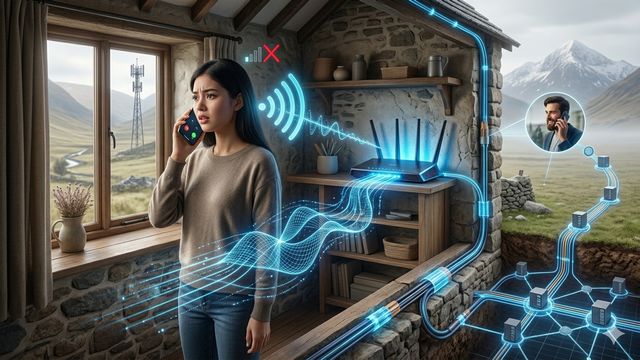
Most people are familiar with making phone calls using a cellular network. When you place a call, your smartphone connects to a nearby cell tower, and your voice travels through the mobile network to reach the person you are calling. However, modern smartphones offer another option known as Wi-Fi calling.
Wi-Fi calling allows users to make and receive phone calls using a Wi-Fi network instead of relying entirely on cellular towers. This feature has become increasingly popular because it helps people stay connected in places where mobile signals are weak but internet access is available.
Although Wi-Fi calling feels exactly like a normal phone call, the technology behind it is fascinating. It combines internet networking, voice processing, encryption, and mobile telecommunications into a seamless experience that most users never notice. Understanding how Wi-Fi calling works reveals how modern communication systems continue to evolve.
The Challenge of Weak Cellular Signals
Cellular networks rely on radio signals transmitted between smartphones and cell towers.
In many situations, these signals may become weak. Large buildings, underground parking garages, remote rural areas, thick walls, and crowded urban environments can interfere with cellular coverage.
When signal strength decreases, call quality often suffers. Users may experience dropped calls, poor audio quality, or difficulty connecting.
To solve this problem, mobile carriers developed Wi-Fi calling.
Instead of forcing phones to depend entirely on cellular towers, Wi-Fi calling allows them to use internet connections that may already be available in homes, offices, schools, airports, and public spaces.
This creates an alternative communication path that can improve reliability.
Everything Begins with Your Voice
Like any phone call, Wi-Fi calling starts when you speak.
Your voice produces sound waves that travel through the air and enter the microphone built into your smartphone.
The microphone converts these sound waves into electrical signals.
Once captured, the phone’s processor converts the electrical signals into digital information.
This process is similar to how music is stored on a computer or smartphone. The sound is transformed into data that electronic systems can process, store, and transmit.
At this point, your voice has become a stream of digital information ready to travel through a network.
Compressing Voice Data
Raw voice data can be quite large.
To make transmission more efficient, smartphones use specialized software known as codecs.
A codec analyzes your voice and compresses the information without significantly reducing quality.
This allows conversations to use less bandwidth while maintaining clear audio.
Modern voice codecs are remarkably advanced. They can preserve natural speech quality while dramatically reducing the amount of data required.
Compression is an essential step because it allows millions of people to make calls simultaneously without overwhelming network infrastructure.
Securing the Conversation
Privacy is an important part of communication.
Before voice data leaves your smartphone, it is encrypted.
Encryption converts the information into a secure format that can only be understood by authorized systems.
If someone were to intercept the data while it traveled across the internet, they would not be able to understand the contents of the conversation.
This security process happens automatically and almost instantly.
Most users never notice it, but encryption plays a crucial role in protecting phone calls from unauthorized access.
Connecting to the Wi-Fi Network
Once the voice data is compressed and encrypted, the smartphone sends it to the nearest Wi-Fi router.
The router acts as a gateway between your local device and the wider internet.
Instead of transmitting radio signals to a cellular tower, the phone communicates with the router using Wi-Fi technology.
Wi-Fi itself uses radio waves, but these signals travel only short distances within homes, offices, or other nearby environments.
The router then forwards the data through the broadband internet connection.
This could be a fiber-optic connection, cable internet service, DSL line, or another form of internet access.
Traveling Through the Internet
After leaving your router, the voice data enters the global internet infrastructure.
The information travels through network equipment operated by internet service providers.
Many parts of the modern internet rely on fiber-optic cables.
These cables transmit data using pulses of light and can carry enormous amounts of information at extremely high speeds.
Your voice data may travel through multiple routers, switches, and network centers before reaching your mobile carrier’s systems.
Despite the complexity of this journey, the entire process usually takes only milliseconds.
The speed is so fast that conversations feel natural and real-time.
Reaching the Mobile Carrier
A common misconception is that Wi-Fi calling completely bypasses mobile carriers.
In reality, the carrier still plays a central role.
Once the data reaches the carrier’s network, specialized servers recognize the incoming Wi-Fi call.
These systems authenticate the user, verify account information, and determine how to route the call.
From the carrier’s perspective, the call functions much like a traditional cellular call.
The only difference is that the initial connection reached the carrier through the internet rather than a nearby cell tower.
This integration allows users to keep their existing phone numbers and calling plans.
Finding the Recipient
After receiving the call request, the carrier must locate the person being called.
The telecommunications network checks whether the destination phone is active and determines how it is currently connected.
The recipient may be using a cellular connection, Wi-Fi calling, or another communication service.
The network establishes a communication path and sends a notification to the receiving device.
When the recipient answers, a two-way communication channel is created.
Both users can now exchange voice data in real time.
Two-Way Communication
One of the most impressive aspects of modern communication systems is simultaneous conversation.
Both participants can speak and listen at the same time.
To achieve this, each phone continuously captures, compresses, encrypts, transmits, receives, decrypts, and reconstructs voice data.
This cycle occurs many times every second.
Powerful processors and network equipment handle these tasks so efficiently that delays are usually imperceptible.
As a result, conversations feel smooth and natural.
Call Quality and High-Definition Audio
Many users notice that Wi-Fi calls can sound exceptionally clear.
This is because strong broadband connections often provide more bandwidth than traditional voice channels.
Carriers can therefore use advanced high-definition voice technologies.
These systems capture a wider range of speech frequencies, making voices sound more natural and easier to understand.
Background noise reduction and echo cancellation further improve call quality.
In many situations, Wi-Fi calling can provide better audio performance than weak cellular connections.
Seamless Switching Between Networks
Modern smartphones are designed to maintain communication even when network conditions change.
Imagine starting a call at home using Wi-Fi and then walking outside.
As the Wi-Fi signal weakens, the phone may automatically switch the call to the cellular network.
This process is called handoff.
Advanced network systems coordinate the transition to prevent the conversation from disconnecting.
Most users never notice the switch occurring.
This seamless experience is one of the reasons Wi-Fi calling has become so popular.
Why Wi-Fi Calling Matters
Wi-Fi calling provides several important benefits.
It improves indoor coverage where cellular signals struggle to penetrate buildings. It helps reduce network congestion by shifting some traffic away from cell towers. It offers better communication in remote locations with reliable internet access. It can also improve call quality and reduce dropped calls.
For mobile carriers, Wi-Fi calling allows existing broadband infrastructure to complement traditional cellular networks.
For users, it creates a more reliable communication experience.
A Smart Combination of Technologies
Wi-Fi calling is an excellent example of how different technologies can work together seamlessly. When you make a Wi-Fi call, your voice is converted into digital data, compressed, encrypted, transmitted through your Wi-Fi network, carried across the internet, processed by your mobile carrier, and delivered to another phone in just fractions of a second.
What feels like a simple conversation is actually the result of sophisticated engineering involving wireless networking, internet infrastructure, digital signal processing, cybersecurity, and telecommunications systems.
Every Wi-Fi call demonstrates how modern technology can transform something as natural as speaking into a highly efficient global communication system. By combining the power of the internet with traditional mobile networks, Wi-Fi calling helps keep people connected wherever reliable internet access is available.