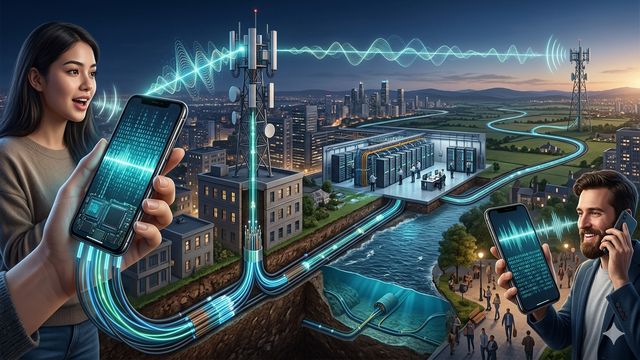
Making a phone call is something most people do without thinking twice. You tap a contact, press the call button, and within seconds you are speaking to someone who may be hundreds or even thousands of kilometers away. The process feels simple, but behind every phone call is an extraordinary combination of physics, electronics, computer science, and telecommunications engineering.
Modern mobile networks perform millions of calculations and data exchanges in a fraction of a second to connect two people. From converting your voice into digital signals to transmitting those signals through radio waves, cell towers, fiber-optic cables, and network servers, every call involves a remarkable technological journey.
Understanding how phone calls work reveals just how sophisticated modern communication systems have become.
Everything Starts with Your Voice
A phone call begins when you speak.
Your voice creates sound waves by vibrating the air around you. These sound waves travel into your phone through a tiny opening called a microphone.
The microphone’s job is to convert these physical sound waves into electrical signals.
Inside the microphone, special components detect the vibrations produced by your voice and transform them into electronic information.
At this stage, your voice is no longer simply sound. It has become a signal that electronic devices can process and transmit.
This conversion is the first step in making long-distance communication possible.
Turning Sound into Digital Data
Modern smartphones do not usually send voice as pure electrical signals.
Instead, they convert your voice into digital information.
The phone rapidly samples your voice thousands of times every second. Each sample measures the characteristics of the sound at that exact moment.
These measurements are converted into binary data consisting of zeros and ones.
This process is called digitization.
By transforming speech into digital information, phones can compress, process, store, and transmit voice more efficiently.
Digital communication also helps reduce noise and improve call quality.
Connecting to the Nearest Cell Tower
Once your voice becomes digital data, it must leave your phone and enter the mobile network.
This happens through radio waves.
Your smartphone contains an antenna that sends and receives radio signals. These signals travel through the air to the nearest cellular tower.
Cell towers are strategically placed to provide network coverage over specific geographic areas known as cells.
The reason the system is called a cellular network is that the entire coverage area is divided into many overlapping cells.
When you move from one location to another, your phone automatically switches between towers without interrupting the call.
This process happens so quickly that users rarely notice it.
Why Cell Towers Are Necessary
Imagine if every phone had to communicate directly with every other phone.
The required transmission power would be enormous, and managing billions of devices would be nearly impossible.
Cell towers solve this problem.
They act as communication hubs that receive signals from nearby phones and forward them through the telecommunications network.
A single tower may serve thousands of users simultaneously.
Advanced technologies help towers manage multiple calls and data connections efficiently.
Without cell towers, modern mobile communication would not be practical.
The Journey Through the Network
After reaching a cell tower, your voice data enters a much larger communication system.
The tower forwards the information through high-speed network infrastructure.
In many cases, this infrastructure consists of fiber-optic cables that transmit data using pulses of light.
Fiber-optic networks can carry enormous amounts of information over long distances at incredible speeds.
The voice data travels through switching centers and network servers that determine the destination of the call.
These systems identify the recipient and establish a communication path between both users.
All of this occurs within fractions of a second.
Finding the Person You Are Calling
When you dial a number, the network must locate the recipient’s phone.
This process is similar to finding a specific address in a large city.
The network checks whether the destination phone is active and connected to a cell tower.
If the phone is available, the network identifies its current location within the cellular system.
A request is then sent to the recipient’s device.
When the person answers, a communication channel is established between both phones.
At that moment, real-time voice exchange becomes possible.
How Two-Way Conversation Works
A phone call is not simply one signal traveling in one direction.
Both people speak and listen simultaneously.
To make this possible, the network continuously transmits voice data in both directions.
Your phone captures your voice and sends it to the network while simultaneously receiving the other person’s voice.
This process occurs many times per second.
Modern communication systems are so fast that the delay is usually too small for humans to notice.
As a result, conversations feel natural and immediate.
The Role of Radio Waves
Radio waves are the invisible carriers that make wireless communication possible.
They belong to the electromagnetic spectrum, which also includes visible light, microwaves, and X-rays.
When your phone transmits data, it encodes information onto radio waves.
These waves travel through the air to the nearest cell tower.
The tower then decodes the information and forwards it through the network.
Different frequency bands are used to support various communication services.
Engineers carefully manage these frequencies to prevent interference and maintain reliable connections.
Why Calls Remain Clear
Modern phone calls often sound remarkably clear despite the complexity of the communication process.
This is possible because of advanced signal processing technologies.
Noise reduction systems remove unwanted background sounds.
Compression algorithms reduce the amount of data required for transmission.
Error correction systems detect and repair minor transmission problems.
Together, these technologies improve call quality and ensure reliable communication even in challenging conditions.
Modern smartphones also contain powerful processors that help manage these tasks in real time.
Internet Calling and VoIP
Many calls today do not travel through traditional voice networks.
Instead, they use internet-based technologies.
This system is known as Voice over Internet Protocol, or VoIP.
Applications such as video calling and internet calling services convert voice into digital packets and transmit them over internet connections.
The underlying concept remains similar: your voice is converted into data, transmitted through networks, and reconstructed at the destination.
The difference is that internet infrastructure carries the information instead of traditional telephone systems.
VoIP has become increasingly popular because it is flexible, scalable, and cost-effective.
What Happens When You Move During a Call?
One impressive feature of cellular networks is mobility.
You can travel in a vehicle while talking without losing the connection.
As you move, your phone continuously monitors nearby towers.
When a stronger tower becomes available, the network transfers your connection from one tower to another.
This process is called a handoff or handover.
The transfer happens automatically and usually takes only milliseconds.
Most users never notice it occurring.
This capability allows uninterrupted communication while moving across cities, highways, and even countries.
The Amazing Science Behind a Simple Call
Making a phone call may seem like a simple everyday action, but it relies on some of the most advanced technologies ever developed. Your voice is transformed into digital data, transmitted through radio waves, routed across cellular networks and fiber-optic systems, and reconstructed almost instantly on another person’s device.
The entire process involves microphones, antennas, cell towers, network servers, radio frequencies, digital signal processing, and sophisticated telecommunications infrastructure working together seamlessly.
Every time you call a friend, family member, or colleague, billions of electronic operations occur behind the scenes within seconds. What feels effortless to users is actually a remarkable achievement of modern science and engineering. Phone calls are a perfect example of how advanced technology has become so integrated into everyday life that we rarely stop to appreciate the incredible systems making global communication possible.