Today, checking the time is effortless. A glance at a smartphone, smartwatch, computer, or wall clock instantly tells us the exact hour, minute, and second. Modern life depends heavily on precise timekeeping, from transportation schedules and business operations to scientific research and communication.
But for most of human history, clocks did not exist. Ancient civilizations had no digital displays, mechanical watches, or alarm clocks. Yet people still needed ways to organize daily activities, plan agriculture, conduct trade, perform religious ceremonies, and navigate long journeys. Over thousands of years, humans developed surprisingly effective methods to measure and track time using nature, astronomy, and simple inventions.
The story of timekeeping before clocks is a fascinating journey that shows how closely early civilizations observed the world around them.
Nature Was Humanity’s First Clock
Long before any timekeeping device existed, people relied on natural cycles.
The rising and setting of the Sun created a predictable pattern of day and night. This cycle became the earliest and most obvious way to measure time.
People learned that sunrise marked the beginning of daily activities, while sunset signaled the time to rest. The changing position of the Sun in the sky provided clues about how much of the day had passed.
Similarly, the phases of the Moon helped ancient people track longer periods of time. The regular cycle from new moon to full moon and back again became the basis for some of the earliest calendars.
Nature provided reliable rhythms that helped communities organize their lives.
Watching the Sun’s Shadow
One of the earliest intentional methods of measuring time involved shadows.
Ancient people noticed that shadows changed length and direction throughout the day. By placing a stick vertically into the ground, they could observe how the shadow moved as the Sun crossed the sky.
This simple observation eventually led to the invention of the sundial.
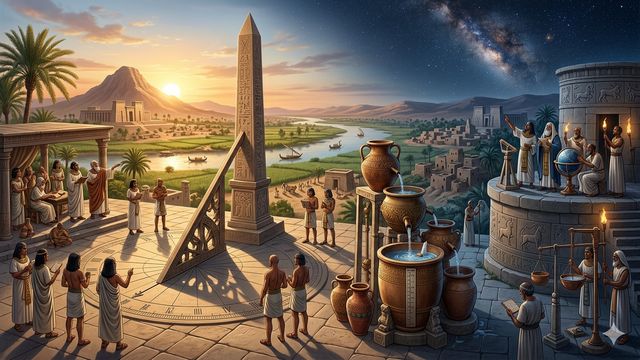
A sundial uses a fixed object, known as a gnomon, to cast a shadow onto a marked surface. As the Sun moves, the shadow changes position, indicating the approximate time.
Sundials became widely used in ancient civilizations because they were simple, reliable, and required no moving parts.
For centuries, they served as one of humanity’s most important timekeeping tools.
The Importance of Astronomy
Ancient civilizations were skilled observers of the night sky.
They carefully tracked the movements of stars, planets, and constellations. These observations helped people determine seasons, predict agricultural cycles, and measure the passage of time.
In places such as ancient Egypt, Mesopotamia, China, and India, astronomers developed detailed records of celestial movements.
Certain stars appeared at predictable times during the year. Their appearance often signaled important seasonal changes, such as planting or harvesting periods.
The night sky effectively served as a giant natural calendar that helped societies organize their activities long before modern clocks existed.
Water Clocks: Measuring Time Indoors
Sundials worked well during sunny days, but they had limitations.
They could not function at night or during cloudy weather. To solve this problem, ancient civilizations developed water clocks.
A water clock measures time through the controlled flow of water.
In one design, water slowly drips from a container at a steady rate. As the water level changes, markings indicate the passage of time.
Some water clocks were remarkably sophisticated and included moving indicators and decorative mechanisms.
Ancient Egyptians, Greeks, Chinese, and other civilizations used water clocks for centuries. They allowed people to track time even when the Sun was not visible.
Using Candles and Oil Lamps
Before mechanical clocks became common, people also used candles and oil lamps to estimate time.
Specially marked candles were designed to burn at a relatively predictable rate. As the candle melted, the markings indicated how much time had passed.
Similarly, some oil lamps were calibrated so that the decreasing oil level could provide an estimate of elapsed time.
These methods were not perfectly accurate, but they offered practical solutions for measuring time indoors and at night.
For many communities, such techniques provided sufficient accuracy for daily life.
The Development of Calendars
Measuring hours was only part of the challenge.
People also needed to track days, months, seasons, and years.
Ancient civilizations developed calendars based on observations of the Sun, Moon, and stars. These systems helped societies coordinate agriculture, religious festivals, trade activities, and government functions.
Many early calendars were lunar, meaning they followed the phases of the Moon. Others combined lunar and solar observations to improve accuracy.
The development of calendars represented a major advancement because it allowed people to plan far into the future rather than focusing only on the current day.
Why Agriculture Required Timekeeping
Agriculture played a major role in the development of time measurement.
Farmers needed to know when to plant crops, irrigate fields, and harvest produce. Missing the correct season could result in poor yields and food shortages.
By carefully observing seasonal changes and astronomical events, ancient societies improved their agricultural planning.
The need for reliable calendars encouraged further advancements in astronomy and timekeeping.
In many ways, the growth of civilization was closely linked to humanity’s ability to understand and measure time.
The Arrival of Mechanical Clocks
For thousands of years, people relied on natural observations and simple devices.
Everything changed during the Middle Ages when mechanical clocks began appearing in Europe.
Unlike sundials and water clocks, mechanical clocks used gears, weights, and mechanical systems to keep time automatically.
Early mechanical clocks were often installed in churches and public buildings. They allowed entire communities to follow a common schedule.
Over time, clock technology improved dramatically. Smaller and more accurate designs eventually led to pocket watches, wristwatches, and modern clocks.
These innovations transformed how societies organized work, transportation, and daily life.
How Accurate Were Ancient Methods?
Compared to modern atomic clocks, ancient timekeeping methods were not highly precise.
However, they were often accurate enough for the needs of the time.
Most people did not need to know the exact minute or second. Knowing whether it was morning, midday, afternoon, or evening was usually sufficient.
Agricultural societies were more concerned with seasons than precise hours. Traders and travelers often relied on general time estimates rather than exact schedules.
As societies became more complex, the demand for greater precision increased, eventually driving the development of advanced clocks.
A Remarkable Human Achievement
The ability to measure time may seem ordinary today, but it represents one of humanity’s greatest intellectual achievements. Long before clocks existed, people carefully studied shadows, tracked celestial movements, observed seasonal patterns, and invented ingenious devices such as sundials and water clocks.
These early methods laid the foundation for modern timekeeping. They allowed civilizations to organize agriculture, coordinate social activities, conduct trade, and deepen their understanding of the natural world.
The next time you check the time on your phone or watch, it is worth remembering that for thousands of years, humans relied on the Sun, Moon, stars, water, and simple observations to understand the passage of time. Their curiosity and ingenuity eventually led to the precise clocks that shape modern life today.