May 25, 2026
Black holes are among the most terrifying and fascinating objects in the universe. They swallow stars, trap light, and bend space and time so violently that nothing can escape once it crosses the event horizon. But what if the universe has an opposite version of a black hole? A strange cosmic object that does not pull things in — but throws them out instead?
This is where the idea of white holes begins.
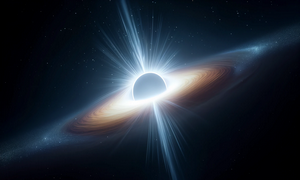
White holes are one of the strangest theories in modern physics. Unlike black holes, which absorb everything around them, white holes are believed to expel matter and energy outward while refusing to let anything enter. In simple words, if a black hole is a cosmic trap, a white hole is a cosmic fountain.
For decades, white holes existed only as mathematical possibilities hidden inside Einstein’s equations. Yet in recent years, some scientists have started revisiting the theory again, wondering whether white holes could help solve one of the greatest mysteries in physics: what really happens to information swallowed by black holes?
The Reverse Side of a Black Hole
Physicists often describe a white hole as a “time-reversed black hole.”
Imagine watching a video of a black hole. Dust, gas, and stars spiral inward and disappear forever beyond the event horizon. Now imagine playing that video backward. Matter suddenly bursts outward from a central point, escaping into space, while nothing is allowed to enter. That reversed picture is essentially what a white hole would look like.
A black hole has a one-way boundary called the event horizon. Once something crosses it, escape becomes impossible. A white hole also has an event horizon, but it works the opposite way. Things can move outward from inside the white hole, but nothing from outside can go in.
In theory, this makes white holes some of the most isolated regions in the cosmos. The outside universe cannot influence what happens inside them.
Einstein’s Equations and the Birth of White Holes
The story of white holes begins with Albert Einstein’s theory of general relativity in 1915. Einstein revealed that gravity is not simply a force pulling objects together. Instead, massive objects bend space and time around them.
Soon after Einstein published his theory, physicist Karl Schwarzschild discovered an exact mathematical solution describing how space-time behaves around a massive object. Hidden within those equations was the possibility of a singularity — a point where matter becomes infinitely dense.
This solution eventually led scientists to the concept of black holes.
But the equations contained something else as well.
General relativity itself does not care which direction time moves. Time could mathematically run forward or backward. If the equations are reversed in time, the black hole solution transforms into a white hole solution.
Why White Holes Sound Impossible
While black holes seem terrifying, white holes almost sound absurd.
A black hole forms naturally when a massive star collapses under its own gravity. Scientists have observed evidence of black holes across the universe. We have even captured images of them.
But no one has ever seen a white hole.
The reason is simple: nature does not seem to behave in reverse.
If you film a glass shattering and play it backward, the broken pieces magically reassemble themselves into a perfect glass. Technically possible in video, but impossible in real life. White holes appear to have the same problem.
A white hole would look like matter suddenly exploding outward in a perfectly organized way. This seems to violate the natural tendency of the universe toward disorder, a principle known as entropy.
Because of this, many scientists believe white holes may be mathematically possible but physically impossible.
Could the Big Bang Have Been a White Hole?
Some physicists have proposed an astonishing idea: what if the Big Bang itself behaved like a white hole?
The universe suddenly expanded from an extremely dense state, releasing enormous amounts of energy and matter outward in all directions. To some researchers, that resembles the behavior expected from a white hole.
Of course, this idea remains speculative. There is no direct evidence proving the universe began as a white hole. Still, the comparison continues to intrigue cosmologists because both involve matter erupting outward from a highly compressed state.
The Black Hole Information Problem
White holes became important again because of a deep mystery involving black holes.
In the 1970s, physicist Stephen Hawking discovered that black holes slowly lose energy through what is now called Hawking radiation. Over incredibly long periods, black holes may eventually evaporate completely.
This created a major problem.
If a black hole disappears, what happens to all the information about the objects it swallowed? According to quantum physics, information cannot simply vanish from existence.
Some scientists believe white holes may offer an answer.
Carlo Rovelli and the White Hole Revival
Physicist Carlo Rovelli and researchers working on quantum gravity have suggested a radical possibility. They propose that black holes might not disappear completely. Instead, after shrinking to extremely tiny sizes, they could transform into white holes.
According to this theory, a black hole eventually reaches a point where quantum effects become stronger than gravity. At that stage, instead of collapsing forever, it “bounces” and becomes a white hole.
The white hole would then slowly release all the information trapped inside during the black hole’s lifetime.
This idea is part of a theory called loop quantum gravity, which attempts to combine Einstein’s relativity with quantum mechanics.
If true, white holes would not be giant glowing cosmic objects. They might instead be tiny remnants smaller than atoms but still containing huge amounts of hidden information.
Why We Have Never Seen One
Even if white holes can exist mathematically, there are several reasons why we may never observe them.
They May Collapse Instantly
A white hole ejecting matter would likely interact with nearby material in space. That interaction could destabilize it immediately, causing it to collapse into a black hole.
This means white holes, if they ever form, might survive only for a tiny fraction of a second.
The Universe Has a Direction of Time
Our universe appears to move in one clear direction — from past to future. Eggs break but do not unbreak. People age instead of growing younger.
Some physicists argue that because the universe has this one-way flow of time, only black holes are physically allowed. White holes may exist only as mathematical mirror images without any real counterpart in nature.
No Evidence Exists
Astronomers have found many strange phenomena in space, but none can confidently be identified as a white hole. Some unusual cosmic explosions and gamma-ray bursts have inspired speculation, but there is no confirmed evidence.
At the moment, white holes remain purely theoretical.
The Strange Beauty of White Holes
Even if white holes never exist physically, they remain deeply important in science.
They force physicists to ask difficult questions about time, gravity, entropy, and the structure of the universe itself. They remind us that mathematics sometimes predicts realities stranger than imagination.
Black holes already challenge our understanding of existence. White holes push that mystery even further. They represent a universe where time may reverse, where endings become beginnings, and where destruction could eventually lead to release.
A Universe Full of Possibilities
Modern physics often sounds like science fiction, yet many impossible ideas later became scientific reality. Black holes themselves were once dismissed as bizarre mathematical fantasies. Today, astronomers photograph them and detect their collisions through gravitational waves.
Will white holes one day make the same journey from theory to reality?
No one knows.
For now, white holes remain cosmic ghosts hidden inside Einstein’s equations — strange doorways that may never open, yet continue to challenge how humanity understands space, time, and the universe itself.