May 25, 2026
Imagine two towns separated by a massive mountain. Normally, people would need to travel all the way around the mountain to reach the other side. But if someone dug a tunnel straight through the mountain, the journey would suddenly become much shorter and easier.
That simple idea helps explain one of the strangest concepts in modern physics: the wormhole.
A wormhole is a theoretical tunnel through space and time that could connect two incredibly distant points in the universe. Instead of traveling millions of light-years across galaxies, a traveler could theoretically enter one side of a wormhole and emerge on the other side within minutes or hours.
For decades, wormholes have fascinated scientists, philosophers, and science-fiction writers alike. They appear in movies, novels, and television shows as gateways for interstellar travel and time travel. But unlike pure fantasy, wormholes actually emerge from real scientific equations connected to Albert Einstein’s theory of general relativity.
The question is: could they really exist?
The Idea Behind Wormholes
To understand wormholes, it helps to first understand how gravity works according to Einstein.
Before Einstein, scientists viewed gravity as a force that pulls objects together. Einstein changed that picture completely. He proposed that massive objects like stars and planets bend the fabric of space and time around them. This bending is what we experience as gravity.
A common example is placing a heavy ball on a stretched rubber sheet. The sheet curves around the ball. Smaller objects rolling nearby naturally move toward the curve.
Now imagine space itself behaving this way.
When enough mass is packed into one place, the curve in space-time becomes extreme. Black holes are believed to form when massive stars collapse under their own gravity so intensely that not even light can escape.
Wormholes take this idea one step further.
Instead of space simply bending inward, what if two distant points in space-time became connected through a tunnel? That tunnel would create a shortcut across the universe.
The Birth of the Wormhole Theory
The roots of wormhole theory go back more than a century.
In 1916, shortly after Einstein published his theory of general relativity, Austrian physicist Ludwig Flamm noticed something strange hidden in the mathematics. While studying solutions related to black holes, he realized another possibility existed — a bridge connecting separate regions of space-time.
Later, in 1935, Einstein and physicist Nathan Rosen explored the idea further. They proposed what became known as the Einstein-Rosen Bridge.
This bridge theoretically connected two distant points through a kind of tunnel in space-time. Eventually, scientists and writers began calling these structures “wormholes.”
The name comes from the idea of a worm crawling through an apple. Instead of traveling around the apple’s surface, the worm cuts directly through the middle to reach the other side faster.
What Would a Wormhole Look Like?
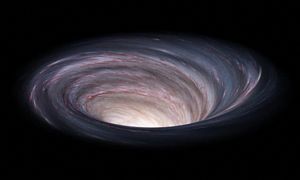
Scientists imagine wormholes as having two openings called “mouths,” connected by a tunnel called a “throat.”
The mouths could appear somewhere far apart in the universe — possibly even in different galaxies. Entering one mouth could allow someone to instantly emerge from the other side.
Some theories even suggest wormholes could connect entirely different universes.
The throat itself might be short and straight, or it could twist and curve through higher dimensions beyond our understanding.
The concept sounds unbelievable, but mathematically, Einstein’s equations do allow for such structures.
Black Holes and Wormholes
Black holes are deeply connected to wormhole theories.
Some scientists speculate that black holes could act as entrances to wormholes. In this picture, matter entering a black hole might theoretically emerge elsewhere through a white hole — the hypothetical opposite of a black hole.
A white hole would push matter outward rather than pulling it inward.
However, there is a major problem: naturally formed black holes do not appear to create stable wormholes. Most likely, anything entering a real black hole would simply be crushed by enormous gravity.
Still, the mathematical relationship between black holes and wormholes continues to intrigue physicists.
Traversable vs. Non-Traversable Wormholes
Not all wormholes are equal.
Some theoretical wormholes would collapse instantly before anything could pass through them. These are called non-traversable wormholes.
Others might remain open long enough for matter, information, or even people to travel through. These are known as traversable wormholes.
Traversable wormholes are the version most often shown in science fiction. Unfortunately, keeping such a tunnel stable appears to require something extremely strange.
The Mystery of Exotic Matter
According to current theories, wormholes would naturally collapse almost immediately because of gravity.
To keep them open, scientists believe they would need a special kind of substance called exotic matter.
Exotic matter is not the same as dark matter or antimatter. Instead, it refers to matter with negative energy density and negative pressure — properties that sound almost impossible in everyday life.
In simple terms, exotic matter would push outward against gravity instead of being pulled inward by it.
Tiny effects similar to negative energy have been observed in quantum physics experiments, but no one knows whether enough exotic matter could exist to stabilize a real wormhole.
Without it, a wormhole would likely pinch shut faster than light could pass through.
Could Wormholes Allow Time Travel?
One reason wormholes capture so much imagination is because they may not only connect distant places — they might connect different times as well.
Some physicists have suggested that if one mouth of a wormhole moved at extremely high speed or experienced intense gravity, time could pass differently at each end.
This could theoretically create a time machine.
A traveler entering one side might emerge years earlier or later than when they entered.
However, this idea remains highly controversial.
Famous physicist Stephen Hawking argued that the laws of physics probably prevent time travel on large scales. He even proposed something called the “chronology protection conjecture,” suggesting nature itself stops paradoxes from happening.
Why Haven’t We Found Wormholes?
Despite decades of research, no confirmed wormhole has ever been discovered.
There are several reasons why.
They Might Be Tiny
Some theories suggest wormholes formed shortly after the Big Bang on microscopic scales far smaller than atoms.
Although cosmic expansion may have stretched some larger over billions of years, we have no evidence of this happening.
They Could Be Extremely Unstable
Even if wormholes exist naturally, they might collapse almost instantly.
The slightest interaction with normal matter could destabilize them completely.
They May Leave Only Subtle Clues
Scientists think wormholes might bend light in unusual ways. Astronomers search for strange gravitational effects that could hint at their presence, but no clear evidence has appeared yet.
Wormholes in Science Fiction
Science fiction has embraced wormholes more enthusiastically than scientists have.
Movies like Interstellar and television series such as Star Trek use wormholes as gateways across the cosmos. They offer a way to avoid the impossible problem of traveling faster than light.
Without wormholes, journeys between stars could take thousands or millions of years. Wormholes provide a fictional shortcut that makes interstellar civilizations possible.
Interestingly, some filmmakers even consult real physicists when designing wormholes to make them scientifically believable.
The Future of Wormhole Research
At the moment, wormholes remain theoretical. No technology exists to create, enlarge, or stabilize one.
But scientists continue studying them because wormholes may reveal deeper truths about gravity, quantum mechanics, and the structure of the universe itself.
Research into wormholes also pushes scientists toward a greater goal: developing a unified theory that combines Einstein’s general relativity with quantum physics.
Even if humans never travel through wormholes, studying them could transform our understanding of reality.
A Universe Stranger Than Imagination
Wormholes sit at the edge of science and imagination.
They challenge the limits of what humans think is possible. They suggest that space and time may be far more flexible than our everyday experience reveals.
Perhaps wormholes are nothing more than mathematical curiosities hidden inside Einstein’s equations. Or perhaps somewhere in the vast darkness of the universe, invisible tunnels quietly connect distant galaxies and unknown worlds.
For now, wormholes remain one of the greatest mysteries in modern science — cosmic doorways that may one day change humanity’s understanding of the universe forever.