May 25, 2026
Black Holes
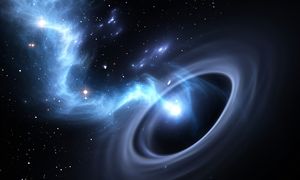
Black holes are among the most mysterious and terrifying objects in the universe. They cannot be seen directly, they swallow light itself, and their gravity is so powerful that once something crosses a certain boundary, escape becomes impossible.
For decades, black holes existed only in theory. Today, scientists know they are real — and the universe may contain millions of them.
Yet despite all the discoveries, black holes remain one of the greatest mysteries in modern science.
What Exactly Is a Black Hole?
A black hole forms when an enormous amount of matter gets squeezed into an incredibly tiny space. This creates gravity so intense that nothing can escape it — not even light.
Normally, if something moves fast enough, it can escape gravity. Rockets escape Earth’s pull. Planets continue moving around stars instead of falling into them.
But black holes are different.
Their gravity becomes so extreme that beyond a certain point, escape is impossible.
This invisible boundary is called the event horizon.
Once anything crosses it — a planet, a star, light, or even time itself — it cannot return.
That is why black holes appear completely dark.
The Giant Hidden at the Center of Our Galaxy
At the center of our galaxy, the Milky Way, lies a gigantic supermassive black hole called Sagittarius A*.
It is about 4 million times heavier than the Sun and sits roughly 26,000 light-years away from Earth.
Even though it is unimaginably massive, it remains invisible. Scientists detect it by studying how nearby stars move around something they cannot see.
In 2022, astronomers released the first-ever image of Sagittarius A*, showing a glowing ring of gas surrounding the dark center.
It was one of the biggest scientific achievements in modern astronomy.
How Black Holes Are Born
Black holes are usually created from dying stars.
A normal star survives because two forces constantly battle each other:
- Gravity tries to crush the star inward.
- Nuclear energy from the star’s core pushes outward.
As long as the star has fuel, these forces remain balanced.
But eventually, the fuel runs out.
When this happens, gravity wins.
The star collapses into itself with enormous force.
If the star is relatively small, it becomes a white dwarf or neutron star.
But if the star is massive enough, the collapse continues until a black hole forms.
Stellar Black Holes: Small But Deadly
These black holes are called stellar black holes because they form from individual stars.
Even though they are considered “small,” they are unbelievably dense.
Imagine squeezing several Suns into an object no larger than a city.
That tiny region would contain gravity powerful enough to trap light itself.
These black holes continue growing by pulling in nearby gas, dust, and even stars.
They are cosmic predators silently feeding in the darkness of space.
Supermassive Black Holes: Monsters of the Cosmos
While stellar black holes are huge, supermassive black holes are on another level entirely.
These giants can contain millions or even billions of solar masses.
Scientists believe nearly every large galaxy has one at its center.
But a major mystery remains:
How do they become so enormous?
Researchers have several theories.
Theory 1: Black Holes Merge Together
One idea is that many smaller black holes gradually collide and merge over billions of years, eventually forming one giant black hole.
Theory 2: Giant Gas Clouds Collapse
Another possibility is that massive clouds of gas in the early universe collapsed directly into black holes without first forming stars.
This would allow supermassive black holes to form surprisingly quickly.
Theory 3: Star Clusters Collapse
Some scientists believe entire star clusters may collapse inward together, creating an enormous black hole at the center.
Theory 4: Dark Matter Plays a Role
Another fascinating theory involves dark matter, the invisible substance believed to make up much of the universe.
Scientists cannot see dark matter directly because it emits no light. They only know it exists because of its gravitational effects.
Some researchers think huge concentrations of dark matter may have helped create supermassive black holes in the early universe.
The Mystery of Intermediate Black Holes
For years, scientists believed black holes came in only two sizes:
- Stellar black holes
- Supermassive black holes
But now researchers believe there may be a middle category called intermediate-mass black holes (IMBHs).
These are thought to contain thousands of solar masses.
Astronomers searched for them for decades because they may explain how supermassive black holes form.
One theory suggests that stars inside crowded clusters repeatedly collide in chain reactions, eventually creating these middle-sized black holes.
In 2014, astronomers found evidence of such a black hole in a spiral galaxy.
Black Holes Can Collide
In 2015, scientists made a groundbreaking discovery.
The LIGO Scientific Collaboration detected gravitational waves for the first time.
These waves came from two black holes colliding far away in space.
This discovery confirmed a prediction made by Albert Einstein nearly 100 years earlier.
When black holes spiral into one another, they shake space itself, creating ripples called gravitational waves.
LIGO’s instruments were so sensitive they detected distortions smaller than the width of an atom.
The discovery changed astronomy forever.
How Binary Black Holes Form
Scientists believe black hole pairs can form in two main ways.
Born Together
Two giant stars may form together, live together, and die together.
When both collapse into black holes, they remain linked as a binary system.
Because the original stars spun in similar ways, the black holes would likely spin similarly too.
Random Pairing in Star Clusters
Another theory suggests black holes drift toward the crowded centers of star clusters and randomly pair together.
In this case, their spins would often point in completely different directions.
LIGO observations showing mismatched spin directions support this second theory strongly.
What Happens If You Fall Into a Black Hole?
This question has fascinated scientists and science-fiction writers for decades.
According to traditional theory, gravity near a black hole becomes so extreme that your body would stretch like spaghetti.
Scientists actually call this spaghettification.
Your feet would feel much stronger gravity than your head, pulling you apart atom by atom.
You would die long before reaching the center, known as the singularity.
The “Wall of Fire” Theory
In 2012, another shocking idea appeared.
Some physicists suggested the event horizon may not be smooth at all.
Instead, it could act like a gigantic wall of fire caused by quantum effects.
According to this theory, anything touching the event horizon would instantly burn to destruction.
Scientists still debate this idea intensely because it challenges some of the deepest laws of physics.
Black Holes Do Not “Suck”
Movies often show black holes behaving like giant vacuum cleaners pulling everything toward them.
But that is not entirely true.
Black holes attract objects through gravity, just like planets and stars do.
If the Sun magically became a black hole of equal mass, Earth would continue orbiting it almost exactly the same way.
The main difference is that the black hole would no longer produce light or heat.
The solar system would freeze in darkness.
The First Black Hole Ever Discovered
The first confirmed black hole was Cygnus X-1.
It lies inside the constellation Cygnus, also known as the Swan.
Astronomers discovered it by observing strange X-rays coming from a nearby star being drained of material.
The invisible object responsible turned out to be a black hole.
This discovery transformed black holes from mathematical ideas into real cosmic objects.
Einstein Predicted Them First
Long before black holes were discovered, Einstein’s theory of general relativity predicted that space and time could bend under gravity.
In 1916, his equations hinted at objects so dense that not even light could escape them.
At the time, many scientists thought such objects were impossible.
The term “black hole” itself was not introduced until 1967 by astronomer John Wheeler.
Today, black holes are considered essential parts of how galaxies evolve.
The Dark Mystery Continues
Despite all the progress, black holes remain deeply mysterious.
Scientists still do not fully understand:
- What happens inside a singularity
- Whether information truly disappears inside black holes
- How supermassive black holes formed so early
- Whether wormholes or other universes could exist inside them
Black holes sit at the edge of modern physics — where gravity, time, space, and quantum mechanics collide.
The more scientists discover about them, the stranger the universe becomes.
And perhaps that is what makes black holes so fascinating.
They are not just cosmic monsters hidden in space.
They are reminders that the universe still holds secrets far beyond human understanding.