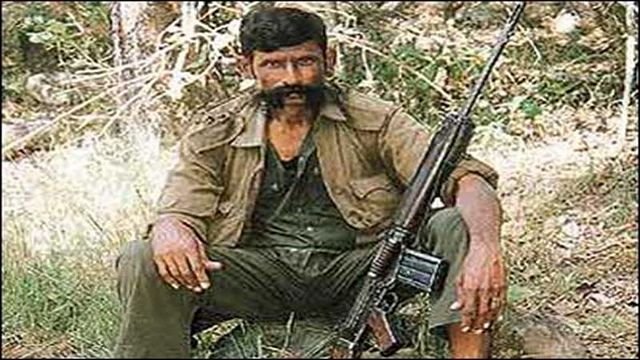
Koose Munisamy Veerappan, often described as India’s most notorious bandit, became a figure of myth and fear in Tamil Nadu and Karnataka. For decades, his ability to evade capture turned him into a symbol of defiance against law enforcement. The story of Veerappan is not merely about crime but about how myth and reality intertwined, challenging the Tamil Nadu police and shaping public perception.
Rise of Veerappan
Born in 1952 in Gopinatham, a village on the Tamil Nadu–Karnataka border, Veerappan grew up in poverty and was drawn to the forests at an early age. His knowledge of the terrain gave him an advantage over law enforcement. Initially involved in poaching elephants for ivory, he later expanded into sandalwood smuggling, building a criminal empire that thrived in the dense forests of the Western Ghats.
His notoriety grew as he amassed wealth and influence, often recruiting locals who saw him as both protector and outlaw. Over time, his name became synonymous with fear, and stories about his exploits blurred the line between fact and folklore.
Myth Versus Reality
Veerappan’s legend was fueled by tales of his cunning escapes and ruthless tactics. Villagers whispered stories of his supernatural ability to vanish into the forest, while others claimed he had divine protection. These myths elevated him to a near-mythical status, complicating police efforts to capture him.
In reality, Veerappan relied on deep knowledge of the terrain, loyal networks, and intimidation to maintain control. His crimes included poaching, smuggling, and kidnapping, with estimates of over 120 murders attributed to his reign. Yet, the myths surrounding him often overshadowed the brutality of his actions, making him a figure of fascination as well as fear.
Tamil Nadu Police and the Long Pursuit
For the Tamil Nadu police, Veerappan represented a formidable challenge. Despite multiple operations, his ability to exploit the forest terrain and local support networks allowed him to evade capture for decades. The Special Task Force (STF), formed in the 1990s, launched extensive manhunts, often involving hundreds of officers.
The pursuit was marked by setbacks, including ambushes and casualties among police personnel. Veerappan’s reputation as a master of guerrilla tactics made him appear invincible, reinforcing the myth that he was beyond the reach of law enforcement.
Kidnappings and National Attention
Veerappan’s notoriety reached national headlines in 2000 when he kidnapped Kannada film star Rajkumar, holding him hostage for 108 days. The incident highlighted his audacity and ability to challenge state authority. Negotiations and public pressure eventually led to Rajkumar’s release, but the episode cemented Veerappan’s image as a figure who could bend governments to his will.
This high-profile case intensified efforts to capture him, with both Tamil Nadu and Karnataka police forces coordinating operations. Yet, his myth continued to grow, with many viewing him as a Robin Hood-like figure despite his violent crimes.
The Final Operation
Veerappan’s reign ended in October 2004 when the Tamil Nadu Special Task Force executed “Operation Cocoon.” Lured into a trap while seeking medical treatment, Veerappan and his associates were killed in an encounter near Dharmapuri. His death marked the conclusion of one of India’s longest manhunts.
The operation was hailed as a major victory for the Tamil Nadu police, dispelling the myth of his invincibility. Yet, his legacy continues to evoke debate—was he merely a ruthless criminal, or did the myths surrounding him reflect deeper social and political realities in rural India?
Legacy of Fear and Fascination
Even after his death, Veerappan remains a subject of books, films, and documentaries. His story illustrates how myth can amplify reality, turning a criminal into a legendary figure. For the Tamil Nadu police, his capture was not only a law enforcement success but also a symbolic victory over decades of fear and folklore.
The myth of Veerappan underscores the challenges of policing in difficult terrains, where local support, cultural narratives, and geography can empower criminals. His life continues to serve as a reminder of the thin line between legend and law.
Conclusion
Veerappan’s story is a blend of myth and reality, where fear and fascination shaped public perception. For Tamil Nadu police, his capture ended a chapter of relentless pursuit and restored faith in law enforcement. The myth of Veerappan may endure, but the truth remains that his reign was built on crime, intimidation, and exploitation. His downfall reaffirmed that no outlaw, however legendary, is beyond the reach of justice.