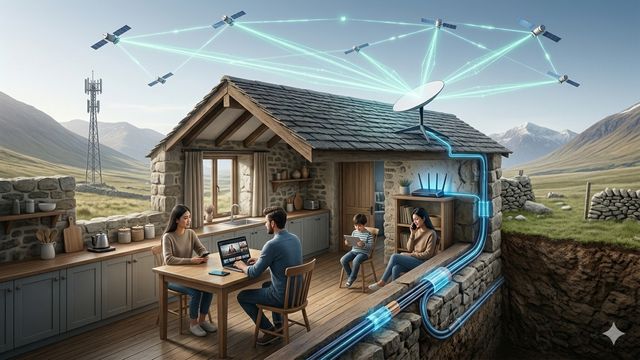
In many parts of the world, accessing fast and reliable internet remains a challenge. Rural villages, remote islands, mountainous regions, and sparsely populated areas often lack access to fiber-optic broadband or high-speed mobile networks. To address this problem, SpaceX, the aerospace company founded by Elon Musk, launched Starlink, a satellite internet service designed to provide broadband connectivity almost anywhere on Earth.
Unlike traditional internet providers that depend on underground cables, telephone lines, or cellular towers, Starlink delivers internet through a massive network of satellites orbiting the planet. The project has attracted global attention because it promises to bring high-speed internet to locations where conventional infrastructure is difficult or expensive to build.
But how does Starlink work, how fast is it, what are its costs, and what challenges does it face? Let’s take a closer look.
What Is Starlink?
Starlink is a satellite-based internet service operated by SpaceX. The system uses thousands of small satellites placed in Low Earth Orbit (LEO), approximately 550 kilometers above the Earth’s surface.
Traditional satellite internet services typically use satellites located about 36,000 kilometers away in geostationary orbit. Because those satellites are so far from Earth, internet signals take longer to travel, resulting in noticeable delays.
Starlink’s satellites orbit much closer to Earth, reducing latency and improving performance. Users connect to the network through a small satellite dish installed at their home or business. This dish automatically tracks satellites passing overhead and communicates with them continuously.
The dish connects to a Wi-Fi router, which distributes internet access throughout the home.
How Fast Is Starlink Internet?
One of Starlink’s biggest advantages is speed.
Depending on location, network congestion, and weather conditions, Starlink users typically experience download speeds ranging from 50 Mbps to over 250 Mbps. Upload speeds often range between 10 Mbps and 30 Mbps.
These speeds are sufficient for:
- HD and 4K video streaming
- Online gaming
- Video conferencing
- Remote work
- Cloud computing
- Online education
- Large file downloads
Latency is another important factor.
Latency refers to the delay between sending and receiving data. Traditional satellite internet often experiences latency of 500 milliseconds or more.
Starlink generally achieves latency between 20 and 50 milliseconds, which is comparable to many terrestrial broadband connections.
This lower latency makes real-time applications such as video calls and online gaming much more practical.
How Starlink Works
The technology behind Starlink is fascinating.
When a user accesses the internet, the device first connects to the Starlink router. The router sends data to the satellite dish installed outside the building.
The dish communicates with a satellite passing overhead. The satellite then forwards the data either to another satellite using laser links or to a ground station connected to the global internet.
The requested information follows the same path back to the user.
This process occurs within fractions of a second.
Because satellites are constantly moving across the sky, the system automatically switches between satellites without interrupting the internet connection.
Availability in India
India has become one of Starlink’s most anticipated markets due to its large population and significant rural areas where broadband access remains limited.
For several years, Starlink faced regulatory hurdles while seeking approval to operate in the country. However, recent developments have moved the service closer to commercial availability.
The company’s long-term goal in India is to provide internet access to remote villages, rural communities, educational institutions, healthcare centers, and businesses that currently have limited connectivity options.
Although fiber networks continue expanding across India, there are still many locations where laying physical cables is difficult or economically impractical. Starlink could help bridge this connectivity gap.
As deployment progresses, availability will likely expand gradually across different regions.
The Cost of Starlink
One of the primary concerns for potential customers is cost.
Unlike traditional broadband services that only require a modem and router, Starlink requires specialized equipment.
The initial package generally includes:
- Satellite dish
- Wi-Fi router
- Mounting hardware
- Power supply
- Cables
This equipment cost can be significantly higher than conventional broadband installation fees.
In addition to the hardware purchase, users pay a monthly subscription fee for internet access.
While pricing varies by country and service plan, Starlink is generally more expensive than standard fiber broadband available in urban areas.
However, for customers living in remote locations with few alternatives, the higher cost may be justified by the improved connectivity.
Advantages of Starlink
1. Internet Access in Remote Areas
The biggest advantage of Starlink is its ability to serve locations where traditional infrastructure is unavailable.
Rural communities, farms, islands, forests, and mountainous regions can gain access to broadband without waiting for cable networks to arrive.
2. High-Speed Connectivity
Compared to many older satellite internet systems, Starlink offers significantly faster speeds and lower latency.
This makes activities such as streaming, remote work, and online education much more practical.
3. Quick Installation
Traditional broadband deployment may require extensive cable installation.
Starlink can often be activated by simply installing the dish and connecting the equipment.
4. Global Coverage Potential
Because the service relies on satellites rather than local infrastructure, it has the potential to provide internet almost anywhere on the planet.
5. Useful During Emergencies
Starlink has demonstrated value during natural disasters and infrastructure failures when traditional communication networks become unavailable.
Challenges Facing Starlink
Despite its advantages, Starlink is not without challenges.
1. Higher Costs
The equipment and subscription fees can be expensive compared to traditional broadband services.
This may limit adoption among price-sensitive customers.
2. Weather Effects
Heavy rain, snow, storms, and other severe weather conditions can sometimes affect signal quality and performance.
Although the system is designed to handle most weather situations, interruptions may occasionally occur.
3. Obstructions
Trees, buildings, and other obstacles can block the satellite signal.
For optimal performance, the dish requires a relatively clear view of the sky.
4. Network Congestion
As more users join the network, speeds may fluctuate in heavily populated regions.
SpaceX continuously launches additional satellites to address growing demand.
5. Space Debris Concerns
Some scientists and astronomers have raised concerns about the increasing number of satellites in orbit.
Managing space traffic and minimizing debris will remain important challenges for the industry.
Is Starlink the Future?
Starlink represents one of the most ambitious internet projects ever attempted. By combining advanced satellite technology with a growing network of Low Earth Orbit satellites, SpaceX is working to make high-speed internet accessible to regions that have historically been left behind.
While it may not replace fiber broadband in cities, it offers a compelling solution for remote and underserved areas where traditional infrastructure is difficult to deploy. The service provides impressive speeds, low latency, and near-global coverage potential, making it one of the most significant developments in telecommunications in recent years.
As satellite technology continues to improve and costs gradually decrease, Starlink could play a major role in connecting millions of people to the digital world. For countries like India, where rural connectivity remains an important challenge, satellite internet may become a valuable complement to existing broadband networks and help bridge the digital divide.