June 02, 2026
Have you ever wondered what happens inside an ATM when you insert your card and withdraw money?
For most people, using an ATM is a routine task. You insert your card, enter a PIN, choose an amount, and within seconds, cash appears. The process feels so simple that it’s easy to forget how much technology is working behind the scenes.
An Automated Teller Machine, commonly known as an ATM, is one of the most widely used banking technologies in the world. It allows customers to perform banking transactions without visiting a bank branch or speaking to a cashier.
From cash withdrawals and balance inquiries to deposits and fund transfers, ATMs have transformed the way people access their money. But how exactly does an ATM know who you are, how much money you have, and whether your transaction should be approved?
Let’s explore what happens every time you use an ATM.
What Is an ATM?
An ATM is a computerized banking machine that allows customers to access their bank accounts securely.
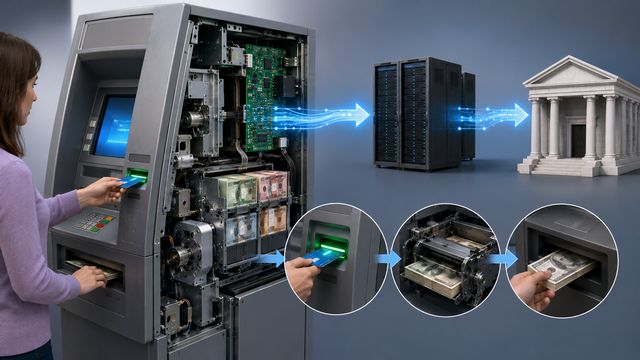
The machine acts as a bridge between the customer and the bank’s central computer systems. Instead of handling transactions manually through a bank employee, the ATM communicates electronically with banking networks to process requests in real time.
Modern ATMs operate 24 hours a day, making banking services available whenever customers need them.
The First Step: Inserting Your Card
Everything begins when you insert your debit or ATM card into the machine.
The card contains important information stored on either a magnetic stripe or an embedded chip. This information includes your account details and unique identification numbers associated with your bank account.
When the card enters the machine, the ATM reads the data stored on it and prepares to verify your identity.
However, simply having the card isn’t enough. The machine still needs confirmation that the card belongs to the person using it.
Why the PIN Is Important
After reading the card, the ATM asks for your Personal Identification Number, commonly called a PIN.
The PIN acts as a security layer that protects your account.
When you enter your PIN, the ATM encrypts the information before sending it through secure banking networks. Encryption converts the data into a coded format that prevents unauthorized access during transmission.
The ATM does not make the approval decision itself. Instead, it forwards the request to your bank’s servers for verification.
If the PIN matches the records stored by the bank, the transaction can continue.
If the PIN is incorrect, the request is rejected.
Connecting to Your Bank
Many people assume the ATM stores account information locally, but that’s not how it works.
Once your card and PIN information are entered, the ATM establishes communication with banking networks.
The machine sends a secure request to the bank that issued your card. This communication often happens within seconds through dedicated financial networks.
Your bank’s computer system checks several details, including:
- Whether the card is valid
- Whether the account is active
- Whether the PIN is correct
- Whether sufficient funds are available
- Whether there are any security restrictions
This entire verification process usually happens so quickly that users hardly notice it.
Choosing a Transaction
After authentication is complete, the ATM displays a menu of available services.
Depending on the machine and bank, customers may be able to:
Withdraw cash, check account balances, transfer funds, change PINs, print mini statements, or deposit money.
When you select a transaction, the ATM sends another request to the bank’s system.
For example, if you request a cash withdrawal, the ATM asks the bank whether the requested amount can be approved.
Only after receiving authorization does the ATM proceed.
How the ATM Knows How Much Money You Have
One of the most impressive aspects of ATM technology is its ability to access account information instantly.
Your account balance is not stored inside the ATM.
Instead, the machine retrieves the information directly from your bank’s database whenever a request is made.
The bank’s servers continuously update account balances as deposits, purchases, transfers, and withdrawals occur.
This allows the ATM to display accurate and up-to-date information within seconds.
Even if you deposited money online moments earlier, your balance may already reflect the change.
The Cash Dispensing Process
Once a withdrawal is approved, the ATM begins preparing the cash.
Inside the machine are secure compartments known as cash cassettes. These cassettes store banknotes of different denominations.
Mechanical rollers and sensors work together to count the exact number of notes required for the transaction.
For example, if you request a specific amount, the ATM calculates how many notes are needed and retrieves them from the appropriate cash cassette.
The machine carefully counts each note to ensure accuracy.
Sensors verify that the correct number of bills has been selected and that no notes are stuck together.
If an error is detected, the ATM automatically corrects the issue before dispensing the cash.
Security Measures Inside the ATM
ATMs handle large amounts of money, making security extremely important.
Modern machines use multiple layers of protection to prevent fraud and theft.
One of the most important security features is encryption. Every piece of sensitive information exchanged between the ATM and the bank is encrypted.
Physical security is equally important.
Cash storage compartments are protected by reinforced steel vaults designed to resist tampering and theft.
Many ATMs are also equipped with surveillance cameras that monitor activity around the machine.
Banks continuously monitor ATM networks to detect suspicious behavior and prevent fraudulent transactions.
What Happens If the ATM Runs Out of Cash?
An ATM can only dispense money if it has enough cash available.
Banks regularly refill ATMs using specially trained cash management teams.
The machine keeps track of how much cash remains inside each cassette.
When supplies become low, alerts are automatically sent to maintenance or banking personnel.
If an ATM runs out of cash, it may temporarily stop processing withdrawal requests until it is replenished.
However, balance inquiries and some other services may still remain available.
How Deposit ATMs Work
Many modern ATMs allow customers to deposit cash and checks.
When cash is deposited, advanced sensors scan and count each banknote individually.
The machine verifies the authenticity of the notes and calculates the total amount being deposited.
For check deposits, image scanners capture digital copies of the check.
These images are transmitted to banking systems for processing and verification.
This technology eliminates the need for manual deposit slips in many situations.
Why ATM Transactions Are So Fast
The speed of ATM transactions often surprises people.
Several factors contribute to this efficiency.
Banking networks are designed to process large volumes of transactions simultaneously. High-speed communication systems allow information to travel between ATMs and bank servers within fractions of a second.
Modern computers can instantly verify account details, check balances, and approve transactions.
At the same time, mechanical components inside the ATM are optimized for rapid cash counting and dispensing.
The result is a transaction process that feels almost instantaneous.
The Future of ATM Technology
ATM technology continues to evolve.
Many newer machines now support contactless transactions, allowing users to access accounts using smartphones or digital wallets instead of physical cards.
Biometric authentication methods such as fingerprint recognition and facial verification are also becoming more common in some regions.
Advanced security systems powered by artificial intelligence are helping banks identify suspicious activity more effectively.
As digital banking grows, ATMs are transforming from simple cash machines into multifunction banking centers that offer a wider range of financial services.
Even in an increasingly digital world, ATMs remain an important part of everyday banking, providing fast, convenient, and secure access to financial services whenever customers need them.