June 02, 2026
Every day, billions of people send messages, watch videos, attend online meetings, scroll through social media, and browse websites without giving much thought to how the internet actually works.
Many imagine that the internet relies heavily on satellites floating in space. While satellites do play a role in global communications, they handle only a small portion of the world’s internet traffic. The vast majority of global data travels through an incredible network hidden deep beneath the oceans.
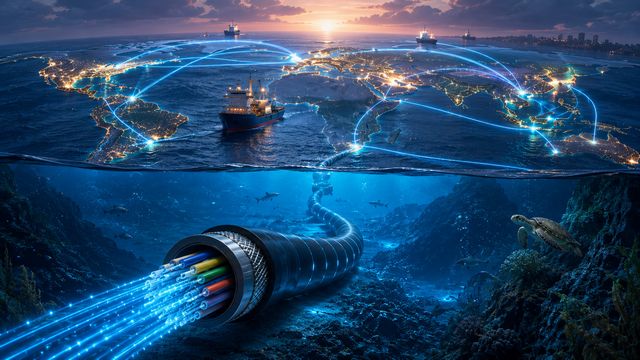
These are undersea cables—massive fiber-optic cables that stretch across the seafloor, connecting continents and carrying enormous amounts of information every second. Although they are rarely seen and often overlooked, these cables form the backbone of the modern internet.
Without them, the digital world as we know it would not exist.
The Internet’s Hidden Highway
Imagine sending a message from India to the United States.
It may seem like the message travels through the air or even through satellites. In reality, it is highly likely that your message travels through a fiber-optic cable lying thousands of meters beneath the ocean.
These cables connect countries and continents, creating a giant communication network that spans the globe. Every time you stream a movie, make a video call, upload a photo, or conduct an online transaction, your data may pass through several undersea cables before reaching its destination.
The process happens so quickly that it feels instantaneous, but behind every click is an extraordinary infrastructure operating silently beneath the sea.
What Are Undersea Cables?
Undersea cables, also known as submarine cables, are specially designed communication cables laid across the ocean floor.
Unlike ordinary electrical cables, modern submarine cables contain fiber-optic strands made of ultra-pure glass. These fibers transmit information using pulses of light.
Light can travel incredibly fast through these fibers, allowing enormous amounts of data to move across continents within fractions of a second.
The cables themselves are surprisingly thin. The core that carries the data may be only slightly thicker than a garden hose. However, multiple protective layers are added to withstand harsh underwater conditions.
These layers protect the cable from pressure, corrosion, fishing equipment, ship anchors, and other potential hazards.
How Data Travels Through a Cable
At the heart of every undersea cable are fiber-optic strands.
When you send data over the internet, that information is converted into light signals. Tiny lasers generate flashes of light that travel through the optical fibers.
These flashes represent digital information, including emails, videos, messages, websites, and financial transactions.
Because light travels so quickly, data can cross entire oceans in milliseconds.
As the signals move through thousands of kilometers of cable, special devices called repeaters amplify the light to maintain signal strength.
Without these repeaters, the signals would weaken before reaching their destination.
Why Not Use Satellites Instead?
Many people assume satellites carry most internet traffic.
The truth is quite different.
While satellites are useful for remote regions and specific applications, they have limitations. Signals must travel thousands of kilometers into space and back, creating delays known as latency.
Undersea fiber-optic cables provide much faster and more reliable communication.
They can also handle vastly larger amounts of data.
A single modern submarine cable can carry terabits of information every second, supporting millions of simultaneous users.
For this reason, more than 95 percent of international internet traffic travels through undersea cables rather than satellites.
The Massive Global Network
There are hundreds of submarine cable systems connecting countries around the world.
Together, they form a global web that links major population centers, financial hubs, cloud data centers, and internet service providers.
Some cables connect neighboring countries, while others stretch across entire oceans.
Certain cable routes span thousands of kilometers without interruption.
These systems create multiple pathways for data to travel. If one route experiences problems, traffic can often be redirected through alternative cables.
This redundancy helps keep the internet running even when disruptions occur.
The Challenge of Installing Undersea Cables
Laying cables across oceans is a remarkable engineering achievement.
The process begins years before the cable ever reaches the water.
Engineers carefully study ocean floors, shipping routes, underwater terrain, geological conditions, and environmental factors. Once the route is planned, specialized cable-laying ships begin the installation process.
The cable is slowly released from enormous spools onboard the vessel while the ship follows a carefully mapped path.
In shallow coastal waters, cables are often buried beneath the seabed for protection.
In deeper parts of the ocean, the cable typically rests directly on the ocean floor.
Some installations cross underwater mountains, deep trenches, and rugged terrain, making the process both complex and expensive.
Life at the Bottom of the Ocean
Many undersea cables spend decades quietly resting on the seafloor.
Contrary to what some people imagine, the deep ocean is not filled with constant threats to these cables. In fact, many sections remain undisturbed for years.
At great depths, cables often become part of the underwater environment. Marine life may gather around them, and sediments gradually settle over portions of the cable.
Despite their isolation, these cables continue transporting enormous volumes of global data every second.
What Happens When a Cable Breaks?
Although submarine cables are built to be extremely durable, damage can still occur.
Fishing equipment, ship anchors, underwater landslides, earthquakes, and natural disasters can sometimes damage cables.
When a cable breaks, internet traffic does not immediately stop worldwide.
Instead, network operators reroute data through alternative cable systems whenever possible.
However, damaged cables can reduce network capacity and occasionally cause slower internet speeds in affected regions.
Repairing a submarine cable is a challenging operation.
Specialized repair ships are dispatched to locate the damaged section. The cable is carefully lifted from the seabed, repaired, tested, and then returned to its original position.
Depending on the location and weather conditions, repairs can take days or even weeks.
The Companies Behind the Network
Building undersea cables requires enormous investment.
Historically, telecommunications companies funded most submarine cable projects.
Today, major technology companies are also investing heavily in global cable infrastructure.
The growing demand for cloud computing, video streaming, artificial intelligence, and digital services has increased the need for faster and more reliable international connections.
As internet usage continues to grow, companies are building new cable systems to support future demand.
These investments help ensure that billions of users can remain connected around the world.
Why Undersea Cables Matter More Than Ever
Modern society depends on instant global communication.
Online banking, international business, cloud computing, video conferencing, streaming services, online education, and social media all rely on undersea cable networks.
Every second, these cables carry financial transactions worth millions of dollars, support global businesses, and connect families separated by thousands of kilometers.
They are among the most important pieces of infrastructure in the modern world, yet most people never see them.
Hidden beneath vast oceans, stretching across continents and connecting nations, undersea cables quietly power nearly every aspect of our digital lives.
The next time you send a message, watch a video, or join a video call, there is a good chance your data is traveling through a fiber-optic cable resting silently on the ocean floor, thousands of meters below the waves.