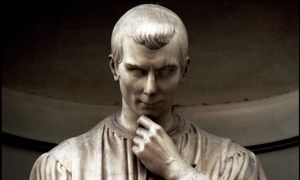
When people hear the name Niccolò Machiavelli, they often think of manipulation, ruthless power, and political schemes. Even today, the word “Machiavellian” is used to describe someone who is cunning, calculating, and willing to do almost anything to achieve power. But Machiavelli was far more complicated than the dark image often attached to his name.
He was not simply a man who encouraged cruelty or dishonesty. He was a deeply observant political thinker who tried to describe the world exactly as it was, not as people wished it to be. At a time when many philosophers spoke about ideal rulers and perfect societies, Machiavelli focused on reality — messy, unstable, dangerous reality.
His writings changed political thought forever because he dared to ask a difficult question: What must a ruler actually do to survive in a chaotic world?
Growing Up in Florence
Machiavelli was born in 1469 in Florence, one of the most powerful and culturally rich cities of Renaissance Italy.
Florence during this period was full of art, political rivalry, wealth, and intellectual energy. It was the age of the Renaissance — the same world that produced artists like Leonardo da Vinci and Michelangelo. But behind the beauty of Florence was constant political instability. Italian city-states were competing against one another. Foreign powers such as France and Spain frequently interfered in Italian politics. Alliances changed quickly. Betrayals were common. Governments rose and collapsed in short periods of time. Machiavelli grew up watching all of this.
His father was a lawyer, and although the family was not extremely wealthy, Machiavelli received an excellent education. He studied grammar, rhetoric, history, and Latin literature. He read ancient Roman writers deeply, especially historians and political thinkers. Interestingly, despite Florence being an important center for Greek studies, Machiavelli never became highly trained in Greek. His intellectual world was shaped more by Roman history and practical politics than abstract philosophy.
Entering Politics
In 1498, when Machiavelli was twenty-nine years old, he entered public service during a turbulent moment in Florentine history.
The powerful Medici family had temporarily lost control of Florence, and a republic had been established. Machiavelli was appointed to important governmental positions, including secretary to the Dieci di Libertà e di Pace — a council responsible for diplomacy and military matters.
This was not a ceremonial role. Machiavelli traveled constantly on diplomatic missions, meeting rulers, generals, ambassadors, and political leaders across Europe. He observed governments closely and studied how power truly worked behind closed doors. Unlike philosophers who only discussed politics in theory, Machiavelli experienced it directly.
He watched leaders lie, manipulate alliances, break promises, and wage war. He saw how quickly governments could collapse when leaders were weak or indecisive. These experiences shaped his understanding of human nature.
The Influence of Cesare Borgia
One figure who deeply influenced Machiavelli was Cesare Borgia. Borgia was ambitious, fearless, intelligent, and often ruthless. He used deception, military strength, and political strategy to expand his power across Italy.
Machiavelli observed him closely during diplomatic missions. While many people saw Borgia as cruel, Machiavelli saw something else too: effectiveness. Borgia understood that political survival sometimes required hard decisions. He moved quickly against enemies, controlled public perception, and eliminated threats before they became dangerous. Machiavelli did not necessarily admire every action Borgia took, but he respected his political skill.
Many historians believe Cesare Borgia became one of the main inspirations behind The Prince.
The Fall of Machiavelli
In 1512, everything changed. The Medici family returned to power in Florence with foreign support. The republic collapsed, and Machiavelli suddenly found himself on the losing side of politics. He was accused of conspiracy against the Medici rulers. Soon he was arrested, imprisoned, and tortured. The torture methods used during the Renaissance were brutal. Machiavelli was subjected to the strappado — a painful punishment in which a person’s hands were tied behind their back and they were suspended by ropes. Although no strong evidence connected him to a conspiracy, political suspicion alone was enough to ruin lives in that era.
Eventually, Machiavelli was released, but he was exiled from political life. For a man whose entire identity revolved around government and diplomacy, this was devastating.
Exile and the Birth of The Prince
After his release, Machiavelli retired to his small country house in San Casciano, outside Florence. At first, exile felt humiliating. He missed politics deeply. In letters to friends, he described spending his days in ordinary activities before retreating at night to read ancient texts and write.
It was during this painful period that he produced his greatest works. Most famous among them was The Prince, written around 1513.
The book was intended partly as an attempt to regain favor with the Medici family. Machiavelli dedicated it to Lorenzo de’ Medici, hoping perhaps to return to public service. Ironically, the Medici ruler barely paid attention to it. Yet the book would eventually become one of the most famous political works in history.
A Radical Break from Traditional Political Thought
Before Machiavelli, politics and morality were usually treated as inseparable. Ancient thinkers like Aristotle believed politics should reflect ethical virtue. A good ruler was expected to be morally good. Machiavelli challenged this tradition completely. He argued that rulers who focus only on morality often fail in the real world.
In The Prince, he famously wrote that there is a huge difference between how people should live and how they actually live. A ruler who ignores reality in favor of idealism risks destruction. This was revolutionary.
Machiavelli essentially separated politics from ethics. He treated politics as its own field, governed by survival, power, strategy, fear, loyalty, and human behavior rather than purely moral principles. This does not mean he believed morality was useless. Rather, he believed political reality often forces leaders into situations where ideal morality alone cannot protect a state.
Was Machiavelli Evil?
For centuries, many people viewed Machiavelli as dangerous or immoral. Some religious authorities condemned his ideas. Others believed he encouraged tyranny and manipulation.
But many modern scholars argue that Machiavelli was not celebrating cruelty — he was describing reality honestly. He understood that power is rarely clean. A ruler may sometimes need to choose between two bad options. Harsh decisions might prevent greater chaos later. Excessive kindness can sometimes weaken governments and lead to disorder. His thinking was uncomfortable because it forced readers to confront difficult truths.
“It Is Better to Be Feared Than Loved”
One of the most famous ideas from The Prince is this: “It is better to be feared than loved, if one cannot be both.”
This sentence is often misunderstood.
Machiavelli was not encouraging pointless cruelty. He was making a practical observation about human nature. Love, he argued, is unstable because people change quickly when circumstances become difficult. Fear, however, is more reliable because people fear consequences. At the same time, Machiavelli warned rulers never to become hated. Fear and hatred are different things. A hated ruler eventually creates rebellion.
Fortune and Human Control
Another important idea in Machiavelli’s writings is fortune — the unpredictable force of luck and circumstance.
He believed life is partly controlled by events outside human control: wars, disasters, political shifts, economic collapse. But he also believed strong leaders could shape events through preparation, courage, and decisiveness. According to Machiavelli, successful rulers do not simply wait for good fortune. They adapt quickly when conditions change.
This idea still feels modern today. Modern politics still reflects many of the patterns he described. Leaders still carefully manage appearances. Governments still use propaganda. Public perception still shapes power. Strong leadership during crises still matters.
The Human Side of Machiavelli
Despite his reputation, Machiavelli was not a cold machine obsessed only with power. He loved literature, theater, and history. He wrote plays, poems, and personal letters filled with humor and emotion.
He was also deeply frustrated by the weakness and division of Italy during his lifetime. Much of his political thinking came from a desire to see Italy stable and united instead of constantly invaded by foreign powers. In many ways, Machiavelli was a disappointed patriot — someone who desperately wanted political strength for his homeland.
The Legacy
Today, Machiavelli remains one of the most debated thinkers in history.
Some see him as cynical. Others see him as realistic. Some believe he exposed the dark side of politics. Others believe he simply described truths people prefer to ignore.
It is that he forced people to confront uncomfortable questions:
- Can morality survive in politics?
- Should leaders always tell the truth?
- Is kindness enough to protect a nation?
- What matters more — ideals or survival?
Machiavelli did not write about the world people hoped existed. He wrote about the world he saw with his own eyes.