June 10, 2026
For most people, the internet begins when they connect their phone to Wi-Fi or open a website on their laptop. Within seconds, videos start playing, messages are delivered, and information from around the world appears on the screen. Because this process happens so quickly, it is easy to forget the enormous infrastructure working behind the scenes.
The internet does not simply appear in our homes. It travels thousands of kilometers through an interconnected network of data centers, fiber-optic cables, telecom systems, and local distribution networks before finally reaching our routers. Companies such as Jio, Airtel, and BSNL play a major role in this journey by delivering internet connectivity from national networks directly to households.
Understanding how the internet reaches your home reveals one of the most remarkable engineering systems ever built.
Where the Internet Begins
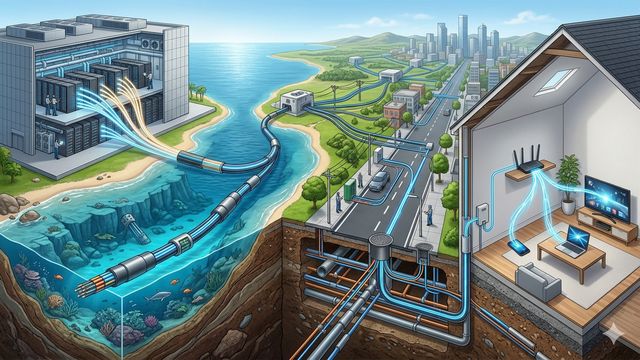
Every website, video, application, and online service exists on servers located in data centers around the world.
A data center is a large facility filled with powerful computers that store and process information. When you visit a website or watch a video, your device sends a request to these servers. The servers then send the requested information back to you.
Some of the world’s largest data centers contain hundreds of thousands of servers operating continuously. These facilities require massive amounts of electricity, cooling systems, and network connections to function.
The internet is essentially a global network connecting these data centers together.
The Role of Undersea Cables
One of the most surprising facts about the internet is that most international internet traffic travels through undersea fiber-optic cables rather than satellites.
Thousands of kilometers of fiber-optic cables lie on the ocean floor, connecting continents across the globe. These cables carry enormous amounts of data using pulses of light.
When someone in India accesses a website hosted in another country, the data often travels through one or more undersea cables before reaching its destination.
These cables form the backbone of the global internet and are responsible for carrying the vast majority of international communications.
Without them, modern internet services would be significantly slower and less reliable.
National Telecom Networks
Once data enters a country, it travels through national telecom infrastructure.
Large telecommunications companies operate extensive fiber-optic networks that connect major cities, business centers, internet exchanges, and regional distribution hubs.
These high-capacity networks function like digital highways, carrying enormous amounts of information across the country every second.
Companies invest heavily in expanding these networks because growing internet usage requires increasing amounts of bandwidth.
As more people stream videos, use cloud services, and connect smart devices, the demand for fast and reliable connectivity continues to rise.
Internet Exchanges and Routing
The internet does not travel through a single direct path.
Instead, data passes through multiple interconnected networks. Internet exchange points help different network operators exchange traffic efficiently.
When you open a website, your request may pass through several networks before reaching the server hosting the content.
Specialized routing equipment determines the most efficient path for the data to travel.
These routing decisions happen in milliseconds and are continuously updated to optimize performance and reliability.
The result is a seamless online experience despite the complexity of the underlying infrastructure.
Regional Distribution Centers
After traveling through national networks, internet traffic reaches regional distribution centers.
These facilities act as connection points between large backbone networks and local service providers.
Regional hubs help distribute internet access to cities, towns, and neighborhoods.
From these centers, data is directed toward local exchanges that serve residential and commercial customers.
This layered approach allows internet providers to efficiently manage millions of connections across vast geographic areas.
Without regional distribution systems, delivering internet services on a large scale would be far more difficult.
Bringing Fiber to Local Neighborhoods
The next stage involves extending connectivity into residential areas.
Internet service providers install fiber-optic cables throughout cities and towns. These cables are often placed underground, attached to utility poles, or routed through dedicated communication infrastructure.
Fiber-optic technology uses light to transmit information at extremely high speeds.
Unlike traditional copper cables, fiber can carry enormous amounts of data over long distances with minimal signal loss.
This makes fiber the preferred technology for modern broadband services.
As fiber networks expand, more households gain access to faster and more reliable internet connections.
The Last Mile Connection
One of the most important parts of internet delivery is known as the “last mile.”
The last mile refers to the final connection between the service provider’s local network and the customer’s home.
This stage often requires significant infrastructure because every household must be connected individually.
Technicians install fiber cables from neighborhood distribution points directly to homes and buildings.
Although this portion represents only a small physical distance compared to the entire network, it is often one of the most expensive and complex parts of deployment.
Successfully completing the last mile allows internet services to reach end users.
What Happens Inside Your Home
Once the fiber cable enters your home, it connects to a device known as an Optical Network Terminal or similar receiving equipment.
This device converts optical signals carried by light into electronic signals that networking equipment can use.
The connection is then linked to a Wi-Fi router.
The router serves as the central hub for internet access inside the home. It manages communication between the internet connection and connected devices.
Every smartphone, laptop, smart television, gaming console, and tablet in the house communicates with the router.
The router ensures that data reaches the correct device while maintaining secure and reliable connections.
How Wi-Fi Reaches Your Phone
Many people assume that the internet reaches their phone directly from the service provider.
In reality, the final step usually occurs through Wi-Fi.
The router broadcasts radio signals throughout the home. Devices equipped with Wi-Fi technology detect these signals and establish connections.
When you open a website on your phone, the request first travels wirelessly to the router.
The router forwards the request through the fiber connection to the service provider’s network. The requested information then travels back through the same path before appearing on your screen.
This entire process often takes only fractions of a second.
Why Fiber Optics Are So Fast
The speed of modern broadband largely comes from fiber-optic technology.
Fiber cables transmit information using pulses of light that travel through extremely thin strands of glass.
Because light moves incredibly fast and experiences minimal interference, fiber networks can deliver much higher speeds than older technologies.
Fiber also supports greater bandwidth, allowing multiple users in the same household to stream videos, attend online meetings, play games, and download files simultaneously.
As internet usage continues to grow, fiber remains the foundation of modern broadband infrastructure.
The Invisible Network Around Us
Most people never see the vast network that powers their internet connection. Undersea cables cross oceans, national fiber networks span countries, regional hubs distribute traffic, and local providers connect homes through sophisticated infrastructure.
Every time a webpage loads, a video streams, or a message is sent, data travels through this enormous system in a matter of milliseconds. What appears to be a simple internet connection is actually the result of countless technologies working together seamlessly.
The next time you connect your phone to Wi-Fi, it is worth remembering that the signal reaching your device has likely traveled through data centers, fiber-optic cables, telecom networks, local exchanges, and routers before arriving in your hand. It is one of the most impressive engineering achievements of the modern world and a technology that billions of people rely on every day.