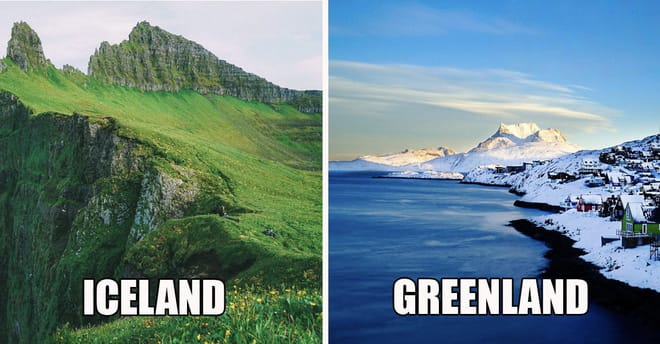
When people hear the names Greenland and Iceland, they often imagine two frozen lands covered in snow and ice. Surprisingly, these neighboring islands are quite different from each other. Their names can even be misleading. Greenland is mostly covered by a massive ice sheet, while Iceland has green valleys, fertile farmland, and active volcanoes. Together, they form two of the most fascinating regions in the North Atlantic.
This article explores the geography, history, climate, culture, and natural wonders of Greenland and Iceland, revealing why these Arctic giants continue to capture the imagination of travelers, scientists, and adventurers from around the world.
The Curious Story Behind Their Names
One of the first questions people ask is why Greenland is so icy and Iceland appears greener than its name suggests.
According to historical accounts, Iceland was named by early Norse settlers who encountered ice-filled fjords and harsh winter conditions. Greenland, on the other hand, was named by the Viking explorer Erik the Red around the year 982. It is believed that he chose the attractive name “Greenland” to encourage settlers to move there. A pleasant-sounding name was a clever way to attract people to a distant land.
Today, Greenland remains covered by an enormous ice sheet that blankets about 80 percent of its surface. Iceland, despite its chilly climate, has many green landscapes, especially during summer.
Geography: Size Matters
Greenland and Iceland differ greatly in size. Greenland is the world’s largest island that is not considered a continent. It covers more than 2 million square kilometers, making it much larger than Iceland.
Iceland is comparatively small, covering about 103,000 square kilometers. Despite its smaller size, Iceland has a remarkable variety of landscapes packed into a compact area.
Greenland is part of North America geographically, although it has strong political and cultural ties to Europe through Denmark. Iceland sits between North America and Europe, making it a unique crossroads between continents.
Climate and Weather
Both islands experience cold climates, but Greenland is generally much colder.
In Greenland, winters can be extremely harsh, especially in the northern regions. Temperatures can fall far below freezing, and vast stretches of ice dominate the landscape. Snow covers many areas for much of the year.
Iceland has a surprisingly moderate climate due to the influence of the North Atlantic Current. Winters are cold but not as severe as many people expect. Summers are cool and pleasant, allowing grass, flowers, and crops to grow in many regions.
The weather in both places can change quickly. A sunny morning may become cloudy and windy within hours, adding to the adventurous nature of visiting these islands.
Nature’s Masterpieces
Greenland and Iceland are famous for their breathtaking natural beauty.
Greenland is known for its towering glaciers, giant icebergs, and dramatic fjords. Some of the world’s largest glaciers can be found there. Massive chunks of ice break away from glaciers and float through the ocean, creating spectacular scenery.
Iceland, meanwhile, is often called the “Land of Fire and Ice.” It combines glaciers with active volcanoes, hot springs, lava fields, and geysers. The country’s geological activity creates landscapes that look almost otherworldly.
Visitors to Iceland can witness erupting geysers, relax in geothermal pools, and explore volcanic caves. Greenland offers opportunities to observe enormous ice formations and experience the raw power of the Arctic wilderness.
Wildlife of the North
Both islands support unique wildlife adapted to cold environments.
Greenland is home to polar bears, Arctic foxes, musk oxen, seals, and whales. The surrounding waters are rich in marine life, making whale watching a popular activity.
Iceland is famous for its seabirds, especially puffins. Millions of birds nest along its cliffs during the breeding season. Whales, seals, and Arctic foxes can also be found there.
The wildlife of these islands demonstrates the remarkable ability of animals to survive in challenging Arctic conditions.
People and Culture
Despite its vast size, Greenland has a small population of around 57,000 people. Most residents live along the coast, where conditions are more suitable for settlements.
Many Greenlanders are of Inuit heritage, and traditional customs remain an important part of daily life. Fishing and hunting have long been central to Greenlandic culture.
Iceland has a much larger population, with over 390,000 people. The majority live in and around the capital city, Reykjavik. Icelandic culture has deep roots in Viking history, literature, and storytelling.
Both societies place great value on community, resilience, and respect for nature. Their cultures have been shaped by centuries of living in challenging northern environments.
The Northern Lights
One of the most magical attractions shared by Greenland and Iceland is the Aurora Borealis, commonly known as the Northern Lights.
This natural phenomenon occurs when charged particles from the Sun interact with Earth’s atmosphere. The result is a dazzling display of green, purple, pink, and blue lights dancing across the night sky.
Both islands are excellent destinations for viewing the Northern Lights during the darker months. Visitors often travel great distances for the chance to witness this unforgettable spectacle.
Tourism and Adventure
Adventure seekers are drawn to both Greenland and Iceland for different reasons.
Greenland appeals to travelers who want to experience untouched Arctic wilderness. Activities include glacier hiking, dog sledding, kayaking among icebergs, and exploring remote settlements.
Iceland offers a wider range of easily accessible attractions. Tourists can drive around the island, visit waterfalls, explore volcanic landscapes, soak in geothermal spas, and enjoy vibrant cultural experiences.
While Iceland has become one of the world’s most popular travel destinations, Greenland remains a more remote and less-visited frontier for explorers.
Environmental Importance
Both Greenland and Iceland play important roles in understanding climate change.
Greenland’s ice sheet contains enough frozen water to significantly raise global sea levels if large portions were to melt. Scientists closely monitor the region to understand how Earth’s climate is changing.
Iceland serves as a natural laboratory for studying volcanoes, glaciers, and geothermal energy. The country is also a leader in renewable energy, using geothermal and hydroelectric power to meet most of its energy needs.
Research conducted in these regions helps scientists better understand our planet and prepare for future environmental challenges.
Conclusion
Greenland and Iceland may share a location in the North Atlantic, but they are remarkably different. Greenland is a vast icy wilderness dominated by glaciers and Arctic landscapes, while Iceland is a land of dramatic contrasts where volcanoes, waterfalls, and green valleys coexist with ice and snow.
Their histories, cultures, wildlife, and natural wonders make them unique destinations worthy of admiration. Whether you are fascinated by giant icebergs, volcanic eruptions, ancient Viking traditions, or the shimmering Northern Lights, both Greenland and Iceland offer unforgettable experiences.
In the end, choosing between Greenland and Iceland is not easy. Each tells a different story of life in the far north. Together, they stand as two extraordinary Arctic giants, reminding us of the beauty, power, and diversity of our planet.