A watch is one of the most common accessories in the world. Today, a simple watch can be purchased for a few hundred rupees, while some luxury watches cost lakhs, crores, or even millions of dollars. This enormous price difference often leads people to ask a simple question: “Why is a luxury watch so expensive when both watches show the same time?”
Brands such as Rolex, Jacob & Co., Patek Philippe, and Audemars Piguet produce some of the most expensive watches in the world. While an ordinary watch focuses mainly on telling time, luxury watches represent a combination of engineering, craftsmanship, artistry, history, exclusivity, and status.
Understanding the difference between normal watches and luxury watches helps explain why some timepieces are considered masterpieces rather than simple accessories.
The Main Purpose Is Still the Same
Whether a watch costs ₹500 or ₹5 crore, both serve the same basic purpose: displaying time.
However, the similarity often ends there.
An ordinary watch is designed primarily for convenience and affordability.
A luxury watch is designed to showcase:
- Precision engineering
- Exceptional craftsmanship
- Premium materials
- Brand heritage
- Mechanical innovation
- Exclusivity
Luxury watches are often considered wearable works of art.
Materials Used
One of the biggest differences lies in the materials.
Ordinary Watches
Most affordable watches use:
- Plastic
- Basic stainless steel
- Mineral glass
- Standard straps
These materials keep production costs low.
Luxury Watches
Luxury brands often use:
- 18K gold
- Platinum
- Titanium
- Sapphire crystal
- Exotic leather
- Precious gemstones
For example, many Rolex watches use specially developed steel alloys that are more corrosion-resistant than ordinary stainless steel.
Jacob & Co. often incorporates diamonds, rare gemstones, and precious metals into its designs.
The material cost alone can be substantial.
Mechanical Engineering
The heart of any watch is its movement.
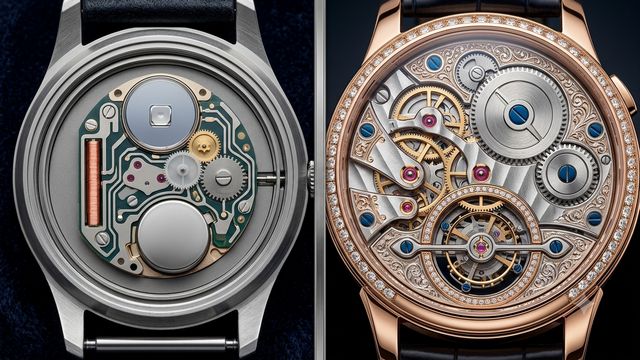
Quartz Watches
Most inexpensive watches use quartz technology.
A battery sends electricity through a quartz crystal.
The crystal vibrates at a precise frequency, keeping accurate time.
Quartz watches are:
- Cheap
- Reliable
- Accurate
- Easy to manufacture
Mechanical Watches
Luxury watches often use mechanical movements.
These movements contain hundreds of tiny components.
They operate without batteries.
Instead, energy comes from:
- Manual winding
- Automatic self-winding systems
The movement is powered entirely through intricate mechanical engineering.
Designing and assembling such systems requires extraordinary skill.
Handcraftsmanship
Mass-produced watches are largely assembled by machines.
Luxury watches often involve extensive hand assembly.
Highly trained watchmakers may spend:
- Weeks
- Months
- Sometimes years
building a single watch.
Each tiny gear, spring, and component must fit perfectly.
Some movements contain more than 1,000 individual parts.
This craftsmanship significantly increases cost.
Watch Complications
In watchmaking, a complication refers to any function beyond simply displaying hours and minutes.
Examples include:
- Calendars
- Moon phases
- Chronographs
- World time displays
- Power reserve indicators
- Tourbillons
Luxury brands compete to create increasingly complex complications.
Jacob & Co. is especially famous for highly complicated watches that display moving astronomical models and miniature mechanical animations.
These features require years of engineering development.
The Tourbillon
One of the most famous luxury watch complications is the tourbillon.
The tourbillon was invented to improve accuracy by compensating for the effects of gravity on a watch’s movement.
Today, it serves more as a demonstration of watchmaking skill.
A tourbillon contains an intricate rotating mechanism that may require hundreds of additional components.
Many tourbillon watches cost several lakhs or crores simply because of the expertise required to manufacture them.
Precision and Testing
Luxury watches undergo extensive testing.
For example, Rolex is known for:
- Water resistance testing
- Shock resistance testing
- Accuracy certification
- Durability testing
Many luxury watches meet strict Swiss chronometer standards.
These standards ensure exceptional precision.
While inexpensive watches can be accurate, luxury brands invest heavily in quality control and long-term reliability.
Brand Heritage
History plays a major role in luxury watch pricing.
Rolex was founded in 1905 and has built a reputation for reliability and innovation.
Many prestigious brands have histories spanning more than a century.
Collectors value:
- Heritage
- Reputation
- Historical achievements
Owning a luxury watch often means owning a piece of watchmaking history.
This intangible value contributes significantly to price.
Exclusivity and Limited Production
Affordable watches are produced in massive quantities.
Luxury watches are often manufactured in limited numbers.
Some models may have waiting lists lasting years.
Limited production creates scarcity.
Scarcity increases demand.
As demand exceeds supply, market values rise.
Certain luxury watches appreciate in value over time.
Watches as Investments
Most ordinary watches lose value after purchase.
Some luxury watches behave differently.
Certain Rolex, Patek Philippe, and Audemars Piguet models have appreciated significantly over time.
Collectors often purchase these watches not only for personal enjoyment but also as investments.
However, not every luxury watch increases in value.
Market demand ultimately determines future prices.
Artistic Design
Luxury watches are often treated as artistic creations.
Jacob & Co. is particularly known for extraordinary designs featuring:
- Rotating globes
- Miniature planets
- Flying tourbillons
- Complex animations
These watches combine engineering with sculpture.
The goal is not simply timekeeping but creating something visually extraordinary.
Status and Prestige
Luxury watches also function as status symbols.
They may communicate:
- Success
- Wealth
- Achievement
- Personal taste
Just as luxury cars and designer fashion carry prestige, high-end watches often serve a similar role.
For many buyers, emotional value is just as important as technical performance.
Why Some Watches Cost Millions
The world’s most expensive watches combine multiple factors:
- Rare materials
- Exceptional craftsmanship
- Complex engineering
- Limited production
- Historical significance
- Precious gemstones
Some watches contain hundreds of diamonds and thousands of hours of labor.
These factors can push prices into the millions of dollars.
Conclusion
Although ordinary watches and luxury watches both tell time, they belong to very different worlds. Standard watches focus on affordability and functionality, while luxury timepieces from brands such as Rolex and Jacob & Co. represent the highest levels of craftsmanship, engineering, design, and exclusivity. Their value comes not only from their ability to measure time but also from the artistry, heritage, materials, and skill invested in their creation.
For many people, a watch is simply a tool. For collectors and enthusiasts, however, a luxury watch is a masterpiece of human engineering—a tiny machine that combines science, art, precision, and tradition on the wrist.