Today, the computer mouse is one of the most familiar devices in the world. Whether using a desktop computer at home, working in an office, or browsing the internet at a school, millions of people use a mouse every day without giving much thought to its name.
But have you ever wondered why this important computer device is called a “mouse”?
After all, a computer mouse has nothing to do with the small furry animal that lives in fields, homes, and forests. Yet somehow, the name became so popular that people around the world accepted it without question.
The story behind the computer mouse is both fascinating and surprising. It involves innovation, engineering, and a simple observation that connected an early computer device to a tiny animal.
Life Before the Mouse
To understand the significance of the mouse, we must first look at the early days of computing.
The first computers were very different from today’s machines.
In the 1940s and 1950s, computers:
- Filled entire rooms
- Cost millions of dollars
- Required trained operators
- Had no graphical interfaces
Users interacted with computers using:
- Punch cards
- Switches
- Keyboards
- Command-line instructions
There was no easy way to point at objects on a screen.
As computers became more advanced, researchers began searching for more natural ways for humans to interact with machines.
The Man Behind the Mouse
The computer mouse is closely associated with Douglas Engelbart.
Engelbart was an American engineer and inventor who believed computers could help humans solve complex problems more effectively.
In the 1960s, he worked at the Stanford Research Institute, where he explored ways to improve human-computer interaction.
His goal was to create tools that made computers easier to use.
One of those tools would eventually become the computer mouse.
The First Mouse
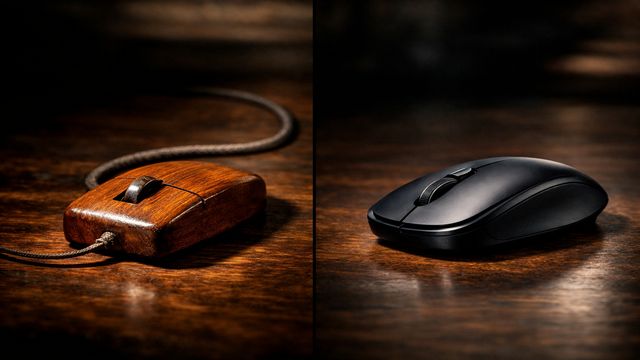
In 1964, Engelbart and his team developed an experimental pointing device.
The early prototype looked very different from modern mice.
It consisted of:
- A wooden shell
- Two metal wheels
- Electronic components
- A connecting wire
The device allowed users to move a cursor across a computer screen.
This was revolutionary at the time.
Instead of typing complex commands, users could simply point and select items.
The invention would eventually change computing forever.
Why Was It Called a Mouse?
The answer is surprisingly simple.
The early device had a wire attached to the back.
When viewed from above, the wire resembled the tail of a mouse.
The small wooden body also vaguely resembled the shape of the animal.
Engineers working on the project began informally referring to it as a “mouse.”
The nickname quickly spread among researchers.
Over time, the informal name became the official name.
Interestingly, no one knows exactly who first used the nickname.
However, the term became so common that it eventually appeared in technical documents and industry discussions.
The name simply stuck.
The First Public Demonstration
The mouse remained largely unknown to the public for several years.
That changed in 1968.
Douglas Engelbart conducted a famous computer demonstration often referred to as “The Mother of All Demos.”
During this event, he showcased:
- The computer mouse
- Hypertext
- Video conferencing
- Collaborative editing
- Graphical interfaces
Many of these technologies were decades ahead of their time.
The demonstration revealed how computers could become interactive tools rather than merely calculating machines.
The mouse played a central role in this vision.
How the Mouse Changed Computing
Initially, many people did not recognize the importance of the mouse.
Computers were still primarily used by researchers and large organizations.
However, as personal computers emerged during the 1970s and 1980s, the value of the mouse became increasingly clear.
The mouse made computers:
- Easier to learn
- Faster to use
- More accessible
- More intuitive
Instead of memorizing commands, users could interact visually with icons, menus, and windows.
This dramatically expanded the appeal of personal computing.
Apple and the Rise of the Mouse
Although Engelbart invented the mouse, other companies helped popularize it.
One of the most influential was Apple.
In the early 1980s, Apple introduced computers that relied heavily on graphical interfaces and mouse control.
Products such as the Apple Macintosh brought mouse-based computing to a much larger audience.
As more people experienced the convenience of point-and-click navigation, the mouse became an essential computer accessory.
How Modern Mice Work
Today’s mice are far more advanced than Engelbart’s original invention.
Modern devices typically use:
- Optical sensors
- Laser sensors
- Wireless communication
- High-precision tracking systems
When a mouse moves across a surface, sensors detect movement and translate it into cursor movement on the screen.
Modern mice can achieve remarkable accuracy and responsiveness.
Some gaming mice can track thousands of movements per second.
Despite these technological improvements, the basic concept remains unchanged.
Different Types of Computer Mice
Over the years, many variations have appeared.
These include:
Mechanical Mice
Used a rolling ball to detect movement.
Optical Mice
Use light sensors instead of mechanical parts.
Laser Mice
Offer improved precision using laser technology.
Wireless Mice
Communicate using radio frequency or Bluetooth technology.
Gaming Mice
Designed for speed, precision, and customization.
Although designs have evolved, all continue to serve the same purpose: helping users interact with computers efficiently.
Will the Mouse Disappear?
Some experts believe future technologies may reduce dependence on traditional mice.
Emerging alternatives include:
- Touchscreens
- Voice control
- Gesture recognition
- Eye tracking
- Virtual reality controllers
However, despite these innovations, the mouse remains highly effective.
For many tasks, especially productivity and precision work, it continues to be one of the most efficient input devices ever created.
More than sixty years after its invention, the mouse remains a central part of computing.
Conclusion
The computer mouse received its name because its early design resembled a small mouse with a tail-like wire extending from the back. What began as a simple nickname among engineers eventually became one of the most recognizable technology terms in the world.
Invented by Douglas Engelbart in the 1960s, the mouse transformed the way humans interact with computers. It helped make computing more intuitive, accessible, and efficient, paving the way for the personal computer revolution. Even as technology continues to evolve, the humble mouse remains one of the most important and influential inventions in the history of computing.