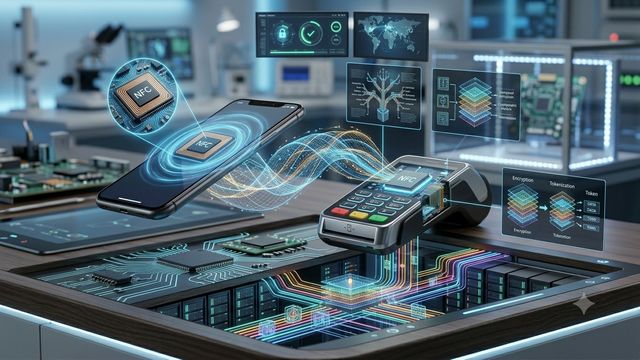
The rise of digital payments has changed how people buy goods and services. Instead of carrying cash or inserting physical cards into payment terminals, many consumers now simply tap their smartphones, smartwatches, or contactless cards to complete transactions. This convenience is made possible by Near Field Communication (NFC) technology.
As contactless payments become more common, many people wonder whether NFC payments are truly safe. Questions about hacking, data theft, and financial fraud often arise whenever new payment technologies are introduced.
The good news is that NFC payments are generally considered one of the safest forms of digital transactions available today. Multiple layers of security work together to protect users, making contactless payments highly secure when used correctly.
Understanding how NFC payment systems work helps explain why financial institutions, technology companies, and millions of consumers trust this technology every day.
What Is NFC?
NFC stands for Near Field Communication.
It is a short-range wireless communication technology that allows devices to exchange information when they are placed very close together, usually within four centimeters.
NFC is commonly used in:
- Smartphones
- Smartwatches
- Contactless credit cards
- Debit cards
- Public transportation systems
- Access control systems
For payments, NFC allows information to be transmitted securely between a payment device and a payment terminal.
The entire process typically takes only a few seconds.
How NFC Payments Work
When you tap your phone or card on a payment terminal, an NFC connection is established.
The payment device communicates with the terminal using encrypted information.
The terminal then sends transaction details to the payment network and the issuing bank for approval.
If everything is verified successfully, the transaction is completed.
The user often receives confirmation almost instantly.
Although the process appears simple, several sophisticated security mechanisms operate behind the scenes.
Why NFC Payments Are Considered Safe
One reason NFC payments are secure is their extremely short communication range.
Unlike Wi-Fi or Bluetooth, NFC only works when devices are very close to one another.
This limited distance makes it difficult for attackers to intercept communications.
A criminal would need to be physically close to both devices at the exact moment of the transaction.
Even then, additional security measures make unauthorized access extremely difficult.
Encryption Protects Your Data
Encryption is one of the most important security features in modern payment systems.
When payment information is transmitted, it is converted into coded data.
Without the correct decryption keys, intercepted information appears meaningless.
Even if someone could somehow capture the transmitted data, they would be unable to read sensitive payment details.
Encryption helps protect information during every stage of the transaction.
This significantly reduces the risk of data theft.
Tokenization Adds Another Layer of Protection
Many modern digital wallets use a security technique called tokenization.
Instead of transmitting the actual credit or debit card number, the system generates a unique digital token.
This token acts as a temporary substitute for the real card information.
The merchant never receives the actual card number.
Even if the token were intercepted, it would be useless for future transactions.
Tokenization is widely regarded as one of the most effective security improvements in modern payment technology.
Biometric Authentication
Most smartphones include advanced authentication features.
Before allowing NFC payments, devices often require:
- Fingerprint scanning
- Facial recognition
- Device PINs
- Password verification
These security measures ensure that only authorized users can initiate payments.
Even if someone steals a smartphone, they may not be able to access the payment system without passing authentication checks.
This additional layer of protection makes mobile NFC payments even more secure than traditional payment cards in many situations.
Comparing NFC Payments to Physical Cards
Traditional payment cards have been used for decades.
However, physical cards can sometimes expose sensitive information.
For example:
- Card numbers are printed on the card.
- Security codes may be visible.
- Cards can be copied through skimming devices.
NFC digital wallets often provide stronger protection because actual card details remain hidden.
Tokenization and biometric authentication create barriers that physical cards typically lack.
As a result, many cybersecurity experts consider smartphone-based NFC payments safer than conventional card transactions.
Common Concerns About NFC Security
Although NFC payments are generally secure, concerns still exist.
Can Someone Steal Money by Walking Nearby?
This is extremely unlikely.
The short communication range means devices must be very close together.
In addition, payment systems require secure authentication and encrypted communication.
Randomly stealing money from nearby users is not a practical attack method.
Can Hackers Intercept NFC Transactions?
While interception is theoretically possible, encryption and tokenization make captured information largely useless.
Modern payment systems are specifically designed to prevent meaningful data theft.
Can a Lost Phone Be Used for Payments?
Most digital wallets require biometric verification or a device passcode.
If a phone is lost, users can often remotely lock or erase it.
This provides additional protection against unauthorized use.
Risks Still Exist
No technology is completely risk-free.
Potential risks include:
- Weak device passwords
- Malware infections
- Phishing attacks
- Social engineering scams
- Stolen unlocked devices
However, these threats generally target user behavior rather than NFC technology itself.
Practicing good cybersecurity habits significantly reduces these risks.
Tips for Safe NFC Payments
Users can improve security by following simple precautions:
Enable Device Locks
Use strong passwords, PINs, fingerprints, or facial recognition.
Keep Software Updated
Security updates often fix vulnerabilities.
Monitor Account Activity
Regularly review banking and payment transactions.
Use Trusted Payment Apps
Only install official payment applications from reputable sources.
Enable Remote Tracking
Many smartphones allow remote locking and data deletion.
These practices provide additional protection against fraud and theft.
The Future of NFC Security
NFC technology continues to evolve.
Future improvements may include:
- Enhanced encryption methods
- Stronger biometric systems
- Artificial intelligence fraud detection
- Advanced digital identity verification
- Improved tokenization techniques
As financial technology advances, payment systems are expected to become even more secure.
Banks, technology companies, and payment providers invest heavily in protecting customer information.
Security remains a top priority as digital payments continue expanding worldwide.
Conclusion
NFC payments are generally very safe and are widely trusted by banks, technology companies, and consumers around the world. Their security comes from multiple protective layers, including short communication ranges, encryption, tokenization, biometric authentication, and advanced fraud detection systems.
While no payment method can guarantee absolute protection, NFC technology offers strong safeguards that make unauthorized access extremely difficult. In many cases, smartphone-based NFC payments are actually more secure than traditional card transactions.
As digital payment systems continue to improve, NFC technology will likely remain one of the safest and most convenient ways to make purchases in an increasingly cashless world.