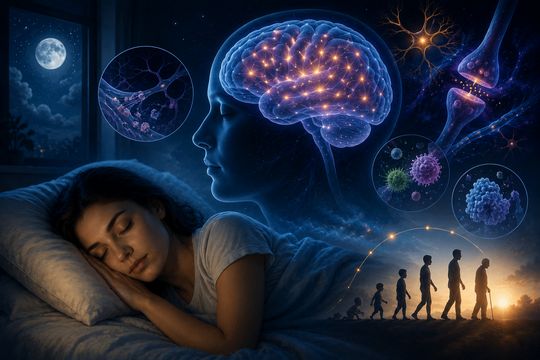
Sleep is one of the most essential activities in human life. Every day, people spend nearly one-third of their lives sleeping, yet many still wonder why it is necessary. Unlike eating, drinking, or breathing, the purpose of sleep is not immediately obvious. During sleep, we become less aware of our surroundings and appear inactive, but inside the body, many important processes are taking place.
Scientists have spent decades studying sleep, and while there is still much to learn, research has revealed that sleep plays a critical role in maintaining physical health, mental well-being, memory, and overall survival. Far from being a period of inactivity, sleep is a highly organized biological process that helps the body and brain function properly.
What Is Sleep?
Sleep is a natural state of rest in which the body reduces its activity and the brain enters specific stages of recovery and maintenance. During sleep, heart rate slows, muscles relax, body temperature decreases slightly, and many internal systems begin repair processes.
Sleep occurs in cycles that include different stages. These stages are broadly divided into non-rapid eye movement (NREM) sleep and rapid eye movement (REM) sleep. Throughout the night, the brain moves repeatedly through these stages, each serving different functions that contribute to health and performance.
A healthy adult typically experiences four to six sleep cycles each night, with each cycle lasting approximately 90 minutes.
Sleep Restores the Brain
One of the most important reasons humans sleep is to allow the brain to recover and recharge. Throughout the day, the brain processes enormous amounts of information, makes decisions, controls body functions, and responds to external stimuli.
During sleep, the brain organizes information collected during waking hours. It processes experiences, strengthens important memories, and removes unnecessary information. Scientists often compare this process to organizing files on a computer.
Without sufficient sleep, concentration becomes difficult, decision-making slows down, and mental performance declines. People who are sleep deprived often experience difficulty focusing, learning new information, and solving problems.
Memory and Learning
Sleep plays a crucial role in learning and memory formation. When people learn new information, the brain initially stores it in a temporary form. During sleep, especially during deep sleep and REM sleep, these memories are strengthened and transferred into long-term storage.
This is one reason students are often advised to get adequate sleep before examinations. Research shows that individuals who sleep well after studying tend to remember information more effectively than those who remain awake for long periods.
Sleep also helps the brain connect ideas and improve creativity. Many people find that problems seem easier to solve after a good night’s sleep because the brain continues processing information even while resting.
Physical Recovery and Repair
Sleep is also essential for physical recovery. During deep sleep, the body begins repairing tissues, muscles, and cells that have been damaged during daily activities.
Growth hormone production increases during sleep, helping repair body tissues and supporting healthy growth in children and adolescents. Athletes often emphasize the importance of sleep because it contributes significantly to muscle recovery and physical performance.
Even minor injuries heal more effectively when a person gets sufficient rest. This demonstrates how closely sleep is connected to the body’s natural repair mechanisms.
Strengthening the Immune System
The immune system depends heavily on quality sleep. While sleeping, the body produces proteins called cytokines, which help fight infections, inflammation, and stress.
People who regularly fail to get enough sleep are generally more susceptible to illnesses such as colds, flu, and other infections. Research has shown that sleep deprivation can weaken the body’s ability to defend itself against disease.
Good sleep therefore serves as an important component of maintaining overall health and supporting the immune system’s effectiveness.
Energy Conservation
Another reason humans sleep is energy conservation. Throughout the day, the body uses significant amounts of energy to support movement, thinking, digestion, and other biological functions.
During sleep, metabolic activity slows down, allowing the body to conserve energy. Heart rate decreases, breathing becomes slower, and energy consumption is reduced.
Although energy conservation alone does not fully explain why humans sleep, it is believed to be one of the important evolutionary advantages of sleep.
Emotional Health and Mental Well-Being
Sleep has a major influence on emotional stability and mental health. People who are well-rested generally manage stress more effectively and experience greater emotional balance.
Lack of sleep can increase irritability, anxiety, frustration, and mood swings. It may also contribute to more serious mental health challenges such as depression and chronic stress disorders.
During REM sleep, the brain processes emotional experiences and helps regulate feelings. This process enables individuals to cope more effectively with daily challenges and emotional events.
Many psychologists consider sleep to be one of the most important foundations of mental well-being.
Cleaning the Brain
One of the most fascinating discoveries in sleep science is that the brain appears to perform a cleaning process while we sleep.
Researchers have identified a system known as the glymphatic system, which becomes more active during sleep. This system helps remove waste products and toxins that accumulate in the brain during waking hours.
Some scientists believe this cleaning process may help reduce the risk of certain neurological disorders later in life. Although research is ongoing, evidence suggests that sleep plays a critical role in maintaining long-term brain health.
Sleep and Human Evolution
Scientists also study sleep from an evolutionary perspective. Every known animal species sleeps in some form, suggesting that sleep provides significant survival advantages.
Early humans likely benefited from sleep because it allowed the body and brain to recover while reducing unnecessary activity during nighttime hours when visibility was limited and risks were higher.
Over thousands of generations, sleep became an essential biological function that supports survival, reproduction, learning, and adaptation.
The fact that sleep exists across nearly all animal species indicates its fundamental importance to life itself.
What Happens When We Don’t Sleep?
The effects of sleep deprivation can be severe. Even one night of poor sleep can affect attention, memory, mood, and reaction time.
Long-term sleep deprivation has been linked to numerous health problems, including obesity, diabetes, heart disease, high blood pressure, weakened immunity, and mental health disorders.
Extreme sleep deprivation can even lead to hallucinations, impaired judgment, and dangerous accidents. Drivers, machine operators, and healthcare professionals are particularly vulnerable to the consequences of insufficient sleep because reduced alertness can affect safety.
These risks highlight how essential sleep is for maintaining normal human functioning.
How Much Sleep Do Humans Need?
Sleep requirements vary depending on age and individual circumstances. Newborn babies may sleep up to 17 hours a day, while teenagers often require 8 to 10 hours.
Most healthy adults need between 7 and 9 hours of sleep each night. Older adults may require slightly less sleep, though quality remains just as important as quantity.
Consistently obtaining adequate sleep helps improve concentration, productivity, physical health, and overall quality of life.
The Future of Sleep Research
Although scientists have learned a great deal about sleep, many questions remain unanswered. Researchers continue to investigate how sleep affects memory, aging, disease prevention, and brain function.
Advances in neuroscience and medical technology are helping scientists better understand the complex relationship between sleep and health. Future discoveries may reveal even more benefits of sleep and lead to improved treatments for sleep disorders.
As research progresses, one fact remains clear: sleep is not simply a period of rest but a vital biological process that supports nearly every aspect of human life.