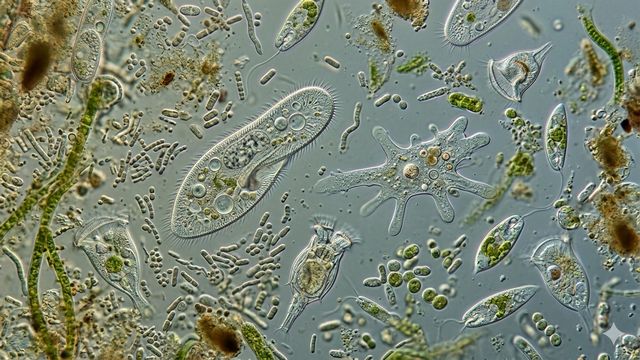
The world around us is filled with life. We can easily see animals, plants, insects, and even tiny creatures such as ants. However, there is another world that exists all around us—a hidden world populated by organisms so small that they cannot be seen with the naked eye. These microscopic organisms live in the air we breathe, the water we drink, the soil beneath our feet, and even inside our own bodies.
Although invisible to us without special equipment, these tiny organisms play a crucial role in maintaining life on Earth. Some help us digest food, others recycle nutrients in nature, and a few can cause diseases. Understanding these microscopic life forms reveals a fascinating universe that most people never notice.
What Are Microscopic Organisms?
Microscopic organisms, often called microorganisms or microbes, are living things that are too small to be seen without a microscope.
The human eye has limitations. Under ideal conditions, most people can only see objects larger than about 0.1 millimeters. Many microorganisms are much smaller than this threshold.
For example, many bacteria measure only one or two micrometers in length. A micrometer is one-millionth of a meter. To understand how small that is, consider that the width of a human hair is approximately 70 to 100 micrometers.
This means dozens of bacteria could fit across a single strand of hair.
The Discovery of the Microscopic World
For most of human history, people had no idea that microscopic organisms existed.
Everything changed in the seventeenth century when early microscopes were developed. One of the pioneers of microscopy was Antonie van Leeuwenhoek, a Dutch scientist who built powerful lenses capable of magnifying tiny objects.
When he examined drops of water, he discovered countless tiny creatures swimming around. He called them “animalcules,” meaning little animals.
This discovery opened an entirely new field of science and transformed humanity’s understanding of life.
Today, advanced microscopes allow scientists to study organisms thousands or even millions of times smaller than what the human eye can detect.
Bacteria: Tiny but Everywhere
Among the most common microscopic organisms are bacteria.
Bacteria are single-celled organisms that exist almost everywhere on Earth. They can be found in oceans, deserts, forests, hot springs, glaciers, and deep underground.
Some bacteria are beneficial. They help decompose dead plants and animals, returning nutrients to the environment. Others assist humans by helping digest food and supporting immune system functions.
Not all bacteria are harmless. Certain species can cause diseases such as tuberculosis, cholera, and pneumonia.
However, most bacteria are either harmless or beneficial.
Without them, ecosystems would struggle to function properly.
The Smallest Free-Living Organisms
Among the tiniest known living organisms is Mycoplasma genitalium.
This bacterium measures only about 0.2 to 0.3 micrometers across.
Despite its tiny size, it contains all the essential components required for independent life.
Scientists are fascinated by organisms like Mycoplasma because they help reveal the minimum requirements for life itself.
Studying these tiny cells provides valuable insights into biology, evolution, and genetics.
Archaea: Life in Extreme Environments
Another group of microscopic organisms is known as archaea.
Archaea resemble bacteria in size but differ significantly in their biological structure.
Many archaea thrive in extreme environments that would be deadly to most other forms of life.
Some live in boiling hot springs, while others survive in highly acidic lakes or deep-sea hydrothermal vents.
These remarkable organisms demonstrate the incredible adaptability of life.
Their existence has expanded scientific understanding of where living things can survive.
Protozoa: Tiny Hunters
Unlike bacteria and archaea, protozoa are more complex organisms.
Protozoa are single-celled organisms that often move actively through water or moist environments.
Some protozoa hunt bacteria and other microorganisms for food.
Although still microscopic, many protozoa are larger than bacteria and possess specialized structures for movement and feeding.
Scientists often study protozoa to better understand cellular behavior and evolution.
These organisms reveal how complex life can emerge even within a single cell.
Microscopic Life Inside the Human Body
Many people are surprised to learn that their bodies contain enormous numbers of microorganisms.
Trillions of bacteria live on human skin, inside the mouth, and throughout the digestive system.
Collectively, these microbial communities are known as the microbiome.
Far from being harmful, many of these organisms perform essential functions.
They help digest food, produce vitamins, and protect against harmful microbes.
Scientists continue discovering new ways in which the microbiome influences health, immunity, and even mental well-being.
The human body is not simply a collection of human cells. It is also an ecosystem supporting countless microscopic organisms.
What About Viruses?
Viruses are even smaller than bacteria.
Virus typically range from about 20 to 300 nanometers in size.
A nanometer is one-billionth of a meter, making viruses among the smallest biological entities known.
Unlike bacteria, viruses cannot reproduce independently.
They must infect living cells and use the host’s machinery to create new virus particles.
Because of this dependence, scientists continue debating whether viruses should be considered truly alive.
Regardless of their classification, viruses have had a profound impact on life throughout Earth’s history.
Why Microscopes Are Essential
Without microscopes, studying microorganisms would be impossible.
Light microscopes use lenses and visible light to magnify tiny objects.
More advanced electron microscopes use beams of electrons to reveal structures far smaller than ordinary microscopes can detect.
Modern microscopy allows scientists to observe individual cells, bacteria, and even some viruses.
These tools have revolutionized medicine, biology, environmental science, and biotechnology.
Many scientific breakthroughs have depended on the ability to see the invisible world.
The Importance of Microorganisms
Although microscopic organisms are tiny, their impact is enormous.
They recycle nutrients, support food production, aid digestion, influence climate processes, and help maintain healthy ecosystems.
Many industries depend on microorganisms.
They are used to produce yogurt, cheese, bread, medicines, vaccines, and various industrial products.
Scientists are also exploring how microbes can help clean pollution, generate renewable energy, and improve agricultural productivity.
In many ways, life on Earth depends on these invisible organisms.
A Hidden Universe Around Us
The microscopic world is one of the most fascinating aspects of science. While we cannot see most microorganisms with our naked eyes, they are constantly present around us and within us. Bacteria, archaea, protozoa, and other microscopic life forms perform essential functions that support ecosystems, human health, and countless natural processes.
Advances in microscopy have revealed that our planet is home to an astonishing diversity of tiny organisms, many of which remain undiscovered. These invisible creatures remind us that size does not determine importance. Some of the smallest organisms on Earth have some of the biggest impacts on life itself.
The next time you look at a drop of water, a handful of soil, or even your own skin, remember that an entire hidden universe of microscopic life may be thriving there—completely invisible, yet incredibly important.