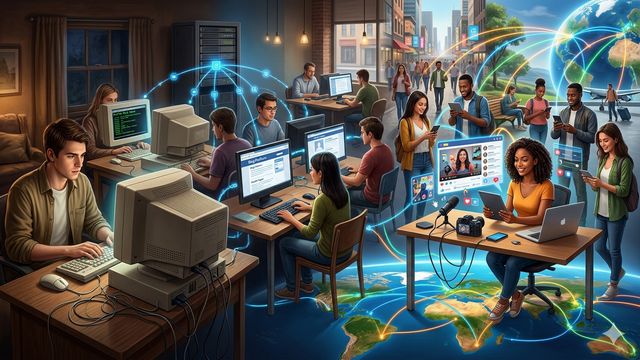
Today, social media is one of the most influential forces in the world. Billions of people use platforms every day to communicate, share experiences, consume news, learn new skills, promote businesses, and stay connected with friends and family. Social media has transformed the way people interact, making it possible to communicate instantly across continents with just a few taps on a screen.
Because social media is now such a normal part of everyday life, it can be difficult to imagine a world without it. Yet only a few decades ago, social media did not exist. The journey from simple online communities to the massive global platforms we know today is a fascinating story of technological innovation, changing human behavior, and the rapid growth of the internet.
Understanding how social media began helps us appreciate how dramatically communication has evolved in a relatively short period of time.
The Internet Before Social Media
To understand the origins of social media, it is important to look at the internet before social networking platforms existed.
During the early years of the internet, communication was much more limited than it is today. Most users accessed information through basic websites that primarily displayed content rather than encouraging interaction.
Email became one of the first widely used forms of online communication. It allowed people to send messages electronically, eliminating the delays associated with traditional mail.
Online discussion boards and forums also became popular. These digital spaces allowed people with shared interests to discuss topics ranging from technology and sports to hobbies and entertainment.
Although these early platforms encouraged communication, they lacked many of the social features that define modern social media.
The Rise of Online Communities
As internet access expanded during the 1990s, people began looking for new ways to connect online.
Chat rooms became increasingly popular. These virtual spaces allowed users to communicate in real time with strangers from around the world.
For many people, chat rooms represented their first experience with online social interaction.
Users could create usernames, join discussions, and form friendships without ever meeting face to face.
These communities demonstrated a fundamental human desire that would later drive the growth of social media: the desire to connect, communicate, and share experiences with others.
The success of online communities revealed the potential for more advanced social networking platforms.
The First Social Networking Websites
The late 1990s saw the emergence of websites specifically designed to connect people.
These early social networking platforms allowed users to create personal profiles and build networks of friends.
For the first time, people could establish an online identity that represented who they were and maintain digital connections with others.
Users could share information about themselves, communicate with friends, and discover new people with similar interests.
Although these platforms were simple by today’s standards, they introduced many concepts that remain central to social media today.
The idea of creating a personal profile and connecting with a network of people became the foundation for future platforms.
Expanding Social Connections
As internet technology improved, social networking websites became more sophisticated.
Users wanted more than basic profiles and friend lists. They wanted to share photos, post updates, communicate instantly, and express themselves creatively.
Developers responded by introducing new features that encouraged greater interaction.
The ability to upload pictures, leave comments, and participate in public discussions transformed social networking into a more engaging experience.
These innovations helped social platforms attract larger audiences and encouraged users to spend more time online.
The internet was gradually shifting from a collection of information websites into a space centered around people and relationships.
The Growth of User-Generated Content
One of the most important developments in social media history was the rise of user-generated content.
Traditional media relied on professional publishers, broadcasters, and journalists to create content for audiences. Social media changed this model entirely.
Instead of simply consuming content, users became creators.
People could publish their thoughts, upload photographs, share videos, and communicate directly with large audiences.
This shift dramatically increased the amount of content available online.
Every user became a potential publisher, capable of reaching friends, communities, or even millions of people.
The ability to create and share content became one of the defining characteristics of social media.
The Smartphone Revolution
The rise of smartphones accelerated the growth of social media more than any other technological development.
Before smartphones became widespread, most people accessed social networks through desktop computers.
This limited how often users could engage with online platforms.
Smartphones changed everything.
With internet-connected devices in their pockets, users could access social media anytime and anywhere.
Photos could be captured and shared instantly. Messages could be exchanged in real time. News, entertainment, and personal updates became available continuously.
The convenience of mobile access transformed social media from an occasional activity into a constant presence in everyday life.
The Introduction of Multimedia Sharing
As internet speeds improved, social media evolved beyond text-based communication.
Photos became a major form of online expression. Users could document daily experiences, share special moments, and communicate visually.
Video sharing soon followed.
The ability to upload and watch videos expanded the possibilities of social media dramatically. Content became more engaging, more entertaining, and more informative.
Multimedia sharing helped social platforms attract broader audiences and increased the amount of time people spent online.
Visual communication eventually became one of the most important aspects of social networking.
Social Media and Global Communication
One reason social media grew so rapidly is its ability to connect people across geographical boundaries.
Distance became less significant as communication became instant.
Friends and family members living in different countries could remain connected through messages, photos, and video calls.
Businesses could reach customers around the world. Communities could form around shared interests regardless of location.
Social media transformed communication from a local experience into a global one.
The ability to interact with people from different cultures and backgrounds created new opportunities for learning, collaboration, and understanding.
The Impact on Society
As social media expanded, its influence extended far beyond personal communication.
Businesses began using social platforms for marketing and customer engagement. Educational institutions incorporated social media into learning experiences. News organizations used social networks to distribute information rapidly.
Political campaigns, social movements, and public awareness initiatives also embraced social media as a communication tool.
The technology became deeply integrated into modern society.
Today, social media influences how people consume information, build relationships, discover products, learn new skills, and participate in public discussions.
Its impact continues to evolve as technology advances.
The Future of Social Media
Social media has changed dramatically since its earliest forms.
What began as simple online communities and chat rooms has evolved into a complex ecosystem of platforms that connect billions of people worldwide.
Emerging technologies such as artificial intelligence, virtual reality, augmented reality, and advanced personalization are likely to shape the next generation of social media experiences.
Future platforms may offer even more immersive and interactive ways for people to communicate and share information.
While the technology continues to change, the fundamental purpose remains the same: helping people connect with one another.
From Simple Connections to a Global Network
The history of social media is ultimately a story about human connection. From early discussion boards and chat rooms to today’s sophisticated platforms, social media has consistently evolved to meet people’s desire to communicate, share experiences, and build relationships.
What started as a small collection of online communities has become a global network that influences nearly every aspect of modern life. The platforms may change, technologies may advance, and new trends may emerge, but the core idea remains remarkably simple: people want to connect with other people.
The next time you open a social media app, it is worth remembering that behind every post, message, photo, and video lies decades of innovation that transformed the internet from a source of information into one of the world’s largest communication networks.