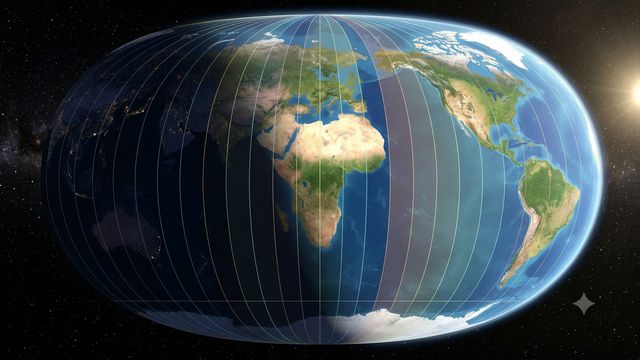
Time plays a crucial role in modern life. Whether it is scheduling international flights, conducting business meetings across continents, watching live global events, or communicating with friends in different countries, people rely on accurate timekeeping every day. However, one question often arises: Why is it daytime in one country while another country experiences night? The answer lies in the system used to calculate international time.
International time is based on the Earth’s rotation, geographic location, and globally accepted standards that allow countries to coordinate their clocks. Without a common system, global communication, transportation, navigation, and commerce would become extremely difficult.
Understanding how international time is calculated reveals one of the most fascinating examples of global scientific cooperation.
Why Different Countries Have Different Times
The primary reason different countries have different times is that the Earth rotates.
The Earth completes one full rotation approximately every 24 hours.
As it rotates, different parts of the planet face the Sun at different times.
When one side of the Earth faces the Sun, it experiences daylight.
The opposite side experiences darkness and nighttime.
Because the Earth is constantly rotating, sunrise, noon, sunset, and midnight occur at different times around the world.
This natural phenomenon makes a global time system necessary.
The Earth’s Rotation and Longitude
The Earth is divided into imaginary lines called longitudes.
These lines run from the North Pole to the South Pole.
A full circle around the Earth contains 360 degrees of longitude.
Since the Earth rotates 360 degrees in approximately 24 hours, scientists calculated that:
- 360 degrees ÷ 24 hours = 15 degrees per hour
This means the Earth rotates approximately 15 degrees every hour.
This calculation became the foundation for the global time zone system.
Every 15 degrees of longitude represents roughly one hour of time difference.
The Prime Meridian
To calculate time globally, a starting point was needed.
The international community selected the Prime Meridian.
The Prime Meridian passes through Royal Observatory Greenwich in England.
This location represents 0 degrees longitude.
Time measurements around the world are calculated relative to this reference point.
Historically, this standard became known as Greenwich Mean Time (GMT).
Today, a more precise system called Coordinated Universal Time (UTC) is widely used.
What Is UTC?
UTC stands for Coordinated Universal Time.
It serves as the world’s primary time standard.
Unlike local times, UTC does not change based on seasons or daylight saving adjustments.
Modern atomic clocks maintain UTC with incredible accuracy.
These clocks measure time using the vibrations of atoms, making them far more precise than traditional mechanical clocks.
Almost all global time zones are expressed as offsets from UTC.
For example:
- India: UTC +5:30
- Japan: UTC +9
- United Kingdom: UTC +0
- New York (standard time): UTC -5
These offsets indicate how many hours a location is ahead of or behind UTC.
Understanding Time Zones
To simplify daily life, the world is divided into time zones.
A time zone is a region where people generally use the same standard time.
Although the ideal time zone width is 15 degrees of longitude, political boundaries often influence actual time zone shapes.
Countries may adjust their time zones for economic, social, or administrative reasons.
For example, some large countries use multiple time zones, while others use only one.
The goal is to keep local noon relatively close to the time when the Sun is highest in the sky.
Why India Uses UTC +5:30
India provides an interesting example.
Instead of using a whole-hour offset, India uses UTC +5:30.
This means India is five and a half hours ahead of UTC.
The country’s official time is known as Indian Standard Time (IST).
IST is based on a longitude of approximately 82.5 degrees east.
Since India spans a large geographical area, a central reference longitude was selected to provide a uniform national time.
This simplifies administration and communication throughout the country.
The International Date Line
One of the most fascinating aspects of international timekeeping is the International Date Line.
The International Date Line is located roughly along 180 degrees longitude in the Pacific Ocean.
Crossing this line changes the calendar date.
When traveling westward across the line, one day is added.
When traveling eastward, one day is subtracted.
Without the International Date Line, the world’s calendar system would become inconsistent.
The line ensures that global dates remain synchronized despite differences in local time.
How Airlines and Navigation Systems Use International Time
International transportation depends heavily on standardized timekeeping.
Airlines often use UTC when planning flights.
Using a universal standard reduces confusion caused by multiple local time zones.
Pilots, air traffic controllers, and aviation systems rely on UTC for communication and scheduling.
Similarly, global navigation systems use precise timing information.
Satellite networks such as GPS depend on extremely accurate clocks.
Even tiny timing errors can result in significant navigation inaccuracies.
Modern technology therefore relies heavily on international time standards.
Atomic Clocks: The Most Accurate Timekeepers
For centuries, humans used sundials, water clocks, pendulums, and mechanical clocks.
Today, atomic clocks provide the world’s most accurate measurements of time.
Atomic clocks use the natural vibrations of atoms to measure seconds.
These clocks are so precise that they would lose only a tiny fraction of a second over millions of years.
Organizations around the world operate atomic clock networks that contribute to maintaining UTC.
This precision supports:
- Internet communication
- Mobile networks
- Financial systems
- Satellite navigation
- Scientific research
Modern society depends on accurate international timekeeping more than ever before.
Daylight Saving Time
Some countries adjust their clocks seasonally through Daylight Saving Time (DST).
The purpose is to make better use of daylight during certain parts of the year.
When DST begins, clocks are moved forward by one hour.
When it ends, clocks return to standard time.
Not all countries observe DST.
Many nations, including India, do not use daylight saving adjustments.
This means their time remains constant throughout the year.
Why International Time Matters
Accurate global timekeeping is essential for countless activities.
Without standardized time:
- International flights would be difficult to schedule.
- Global business meetings would become confusing.
- Financial markets could not coordinate transactions efficiently.
- Internet systems would struggle to synchronize data.
- Navigation systems would become unreliable.
International time allows billions of people to coordinate activities despite living in different parts of the world.
It serves as an invisible foundation supporting modern civilization.
Conclusion
International time is calculated using the Earth’s rotation, longitude lines, time zones, and globally accepted standards such as UTC. By dividing the planet into time zones and using a common reference point at the Prime Meridian, countries can maintain synchronized timekeeping while accounting for their geographic locations.
Modern atomic clocks provide extraordinary precision, enabling everything from global communication and satellite navigation to financial transactions and international travel. Although the system may seem complex, it ensures that people around the world can coordinate their activities accurately and efficiently.
Every time someone checks a world clock, books an international flight, or joins an online meeting with people from another continent, they are benefiting from one of humanity’s most important scientific and organizational achievements: the global system of international timekeeping.