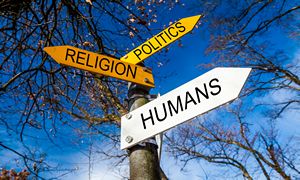
Yellow and white decision signs on a tree
Religion and politics have influenced human society for centuries. Sometimes they worked together, sometimes they fought each other, and at other times one tried to control the other. Both seek influence over people and society, but they operate in very different ways.
Religion usually appeals to faith, morality, and spiritual beliefs. Politics, on the other hand, works through laws, administration, public opinion, diplomacy, and power. When these two forces come together, societies can be shaped deeply—for good or for harm.
Throughout history, different civilizations experimented with different relationships between religion and political authority. Some rulers used religion to strengthen their rule. Some religious groups tried to control governments completely. Others believed religion and politics should remain separate.
The relationship between religion and politics has never been simple. It has always been shaped by power, fear, belief, culture, and changing social conditions.
The Different Nature of Religion and Politics
Religion often claims that its authority comes from God or divine truth. Because of this, religious laws are usually treated as sacred and unchangeable. Religious institutions often believe they are guiding society toward moral and spiritual purity.
Politics is different. Political systems are usually built around practical needs. Governments must respond to economic problems, wars, social changes, technology, and public demands. Political laws can change according to circumstances.
This creates tension between the two. Religion tends to preserve tradition. Politics often needs flexibility and adaptation. Religion may say truth is eternal. Politics usually deals with compromise and changing realities.
Three Historical Models of Religion and Politics
Over time, history shows three major patterns in the relationship between religion and politics.
1. Religion and Politics Working Together
In this model, religion and political authority unite and support each other. Rulers use religion to legitimize their rule, while religious scholars gain influence and protection from the state. This partnership can create stability, but it can also lead to abuse of power because both institutions protect each other.
2. Politics Dominating Religion
Here, rulers allow religion to exist but keep it under political control. Religious leaders become dependent on the state and often serve political interests instead of spiritual ones. Religion becomes a tool of rulers rather than an independent moral force.
3. Religion and Politics in Conflict
In this model, religion and political authority compete against each other. Religious groups challenge rulers, while rulers try to suppress religious influence. Sometimes this leads to separation between religion and state. At other times, it produces revolutions, extremism, or violent struggles.
How Religions Change Over Time
Every religion begins in a specific historical period. It responds to the problems and conditions of its own society. But as centuries pass, societies change. New scientific discoveries appear. Economic systems evolve. Technology transforms daily life. Ideas about freedom, equality, and identity shift.
Religions then face a difficult question: Should they adapt to changing times, or preserve older traditions exactly as they are?
Some religious movements accept reinterpretation and modernization. Others resist any change, believing it weakens the faith. Often, reformers who attempt new interpretations face opposition. They may be accused of betraying religion or corrupting tradition. Yet history also shows that when religions completely refuse adaptation, they sometimes lose influence over society.
Religion and Politics in Islamic History
The relationship between religion and political authority became especially important in Islamic history after the Abbasid Revolution in 750 CE. The Abbasid rulers inherited a vast empire that included Persian political traditions. Iranian administrators influenced the Abbasid court heavily and transformed the caliph into a king-like ruler similar to Persian emperors. The caliph gained enormous political power, while religious scholars—the ulema—focused mainly on religious law (shariat).
An informal division emerged:
- The ruler controlled politics and administration.
- Religious scholars controlled religious interpretation.
This arrangement effectively separated political authority from religious authority, even though both still cooperated closely.
The Rise of Absolute Kingship
As Islamic empires expanded, rulers became increasingly powerful. Courts grew luxurious. Kings adopted grand titles and elaborate ceremonies. Religious scholars often joined the state system as judges, advisors, prayer leaders, and legal interpreters.
Sometimes rulers even asked scholars to issue religious rulings (fatwas) to justify political actions. This created a dangerous relationship where religion was sometimes used to support royal desires rather than moral principles.
The “Mirror for Princes”
During the medieval Islamic period, many scholars wrote books advising kings how to rule. These books, known as “Mirror for Princes” literature, accepted monarchy as necessary for maintaining order. Writers such as Nizam al-Mulk and Ghazali emphasized that rulers must be strong but also just. Kings were described as the “Shadow of God” on earth. This idea gave rulers enormous authority. However, scholars also warned kings to rule with fairness and wisdom because injustice could destroy kingdoms. This was an attempt to balance absolute political power with moral responsibility.
Akbar and a New Vision of Kingship
The Mughal emperor Akbar in India developed a different approach. Unlike many earlier rulers, Akbar believed the king should have authority above religious scholars. His advisor Abul Fazl argued that kingship itself was a divine responsibility aimed at protecting public welfare.
Akbar introduced reforms that challenged old traditions:
- He discouraged child marriage.
- He tried to reduce harmful customs like sati.
- He encouraged debates between different religions.
Eventually, Akbar even gained authority to interpret religious matters himself, reducing the political influence of orthodox scholars. This was revolutionary because it placed political leadership above religious authority.
When Religion Became a Tool of Politics
Many rulers throughout history used religion strategically. Aurangzeb, for example, sometimes used religious rulings to justify political decisions against rivals. Although his actions were often political, they were presented as religiously necessary.
This pattern appeared repeatedly in history:
- Political enemies labeled as heretics.
- Religious laws used selectively.
- Scholars pressured to support rulers.
In such systems, religion often lost its independence and became closely tied to state power.
Religious Movements Against Political Power
Not everyone accepted political domination over religion. Some religious scholars believed rulers had become corrupt and too worldly. Movements emerged demanding stricter implementation of religious law.
One famous example was Ibn Taymiyyah, who argued that religious scholars should play a stronger role in public life.
Other reform movements attempted to create “pure” religious societies by challenging rulers directly. But many of these movements became extreme and intolerant. They often failed because ordinary people grew tired of harsh restrictions and rigid control.
Religious Rule and Social Control
History shows that states governed entirely by religious ideology often use strict control over society. One example outside the Islamic world was Calvin’s Geneva in Europe. Religious authorities monitored personal behavior closely:
- Entertainment was restricted.
- Public morality was enforced.
- Severe punishments were common.
Similarly, later religious movements in parts of the Muslim world attempted to create morally “pure” societies through coercion. The Taliban in Afghanistan is one modern example where religion and political power became deeply fused. In many such systems, personal freedom, art, creativity, and intellectual diversity suffer.
Colonialism and the Separation of Religion and Politics
The arrival of European colonial powers changed Muslim societies dramatically. Colonial governments introduced:
- Modern legal systems
- Bureaucracies
- Nationalism
- Secular education
- New political ideas
Religion was increasingly pushed into the private sphere. This produced two major responses:
- Reformers who wanted to modernize religion.
- Revivalist groups who wanted to restore religious political authority.
Modern Nationalism and Religious Identity
In the modern era, nationalism became a powerful force. Many countries built national identities based on language, territory, or ethnicity rather than religion alone. This allowed people of different faiths to unite politically.
However, in some places religion became the basis of national identity itself. This often created divisions between religious majorities and minorities. When religion becomes state ideology, it can affect:
- Education
- Law
- Science
- Culture
- Citizenship rights
Critics argue that such systems reduce intellectual freedom and discourage creative thinking.
The Ongoing Debate And Final Reflection
The debate between religion and politics continues even today. Religion and politics are two of the most powerful forces in human history. Both shape identities, values, and institutions. Both can unite people or divide them. Some believe religion provides moral guidance necessary for society. Others fear that mixing religion with political power leads to authoritarianism and intolerance.
History does not offer one simple answer. Sometimes religion inspired justice, charity, and social reform. Sometimes political rulers protected stability and order.
But history also shows the dangers when either religion or politics gains unchecked power. The healthiest societies are often those that allow belief, discussion, criticism, and adaptation without forcing absolute control.