June 05, 2026
Every day, billions of people browse websites, watch videos, send emails, use social media, and store files online. Most of these activities happen within seconds, making the internet feel almost magical. However, behind every website, application, and online service is a powerful technology that makes it all possible: the server.
Although most people interact with the internet daily, few understand what servers are or how they work. Servers are one of the most important components of modern technology. Without them, the internet as we know it simply would not exist.
From streaming your favorite movies to processing online payments, servers quietly handle countless tasks every second. Understanding how they work provides valuable insight into the digital world that powers modern life.
What Is a Server?
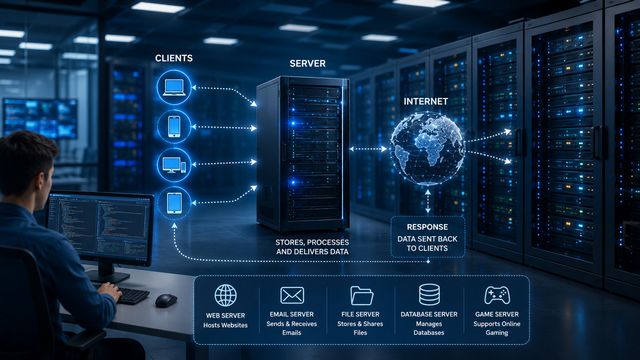
A server is a computer or software system that provides services, data, or resources to other computers, known as clients.
When you visit a website, your device acts as the client. The website’s server stores the website’s content and sends the necessary information back to your browser when requested.
Think of a server as a restaurant kitchen. Customers place orders, and the kitchen prepares and delivers the requested food. Similarly, when a user requests information online, the server processes the request and delivers the required data.
Servers are designed to handle many requests simultaneously, making them much more powerful and reliable than typical personal computers.
Why Servers Are Important
Almost every online service depends on servers.
When you watch a video online, a server delivers the video data to your device. When you send an email, a server receives, stores, and forwards the message. When you shop online, servers manage product information, user accounts, payment processing, and order tracking.
Without servers, websites would not load, online games would not function, and cloud storage services would not exist.
They serve as the foundation of the internet and modern digital communication.
How a Server Responds to a Request
To understand how servers work, imagine typing a website address into your browser.
The moment you press Enter, your browser sends a request across the internet asking for the website’s content.
This request travels through various network systems until it reaches the appropriate server.
Once the server receives the request, it processes the information and determines what data needs to be sent back. The server then responds by delivering files such as text, images, videos, and website code.
Your browser receives this information and assembles it into the webpage you see on your screen.
This entire process usually takes only a few seconds or less.
Different Types of Servers
Not all servers perform the same function.
Web servers are responsible for hosting websites and delivering web pages to visitors. Whenever you browse the internet, you are interacting with web servers.
Email servers manage electronic messages. They receive emails, store them temporarily, and deliver them to recipients.
File servers store documents, images, videos, and other files that users can access over a network.
Database servers manage large collections of information. They store customer records, product catalogs, financial data, and countless other forms of digital information.
Game servers power multiplayer online games by managing player interactions and maintaining synchronized game environments.
Each type of server is optimized for specific tasks, allowing modern digital services to operate efficiently.
Where Are Servers Located?
Many people imagine servers as invisible parts of the internet floating somewhere in cyberspace. In reality, servers are physical machines located in buildings known as data centers.
Data centers are specialized facilities designed to house thousands of servers.
These facilities provide reliable electricity, cooling systems, network connections, and security measures to ensure servers operate continuously.
Some of the world’s largest technology companies operate enormous data centers containing tens of thousands of servers. These facilities handle millions of user requests every day.
Because servers generate significant heat, advanced cooling systems are essential to prevent overheating and maintain performance.
What Happens Inside a Data Center?
A data center may look like a warehouse filled with rows of tall cabinets.
Inside these cabinets are powerful server machines connected to high-speed networks. Each server contains processors, memory, storage devices, and networking equipment.
When users interact with online services, data travels to and from these servers at incredible speeds.
Data centers are designed for reliability. Backup power generators, multiple internet connections, and redundant hardware help ensure services remain available even during equipment failures or power outages.
This high level of reliability is critical because millions of people depend on online services every day.
The Rise of Cloud Computing
In recent years, cloud computing has transformed how servers are used.
Traditionally, businesses purchased and maintained their own physical servers. This approach often required significant investment in hardware, maintenance, and technical expertise.
Cloud computing allows organizations to rent server resources from large technology providers instead.
Rather than owning physical machines, businesses can access computing power, storage, and applications through the internet.
This model provides flexibility and scalability. Companies can quickly increase or decrease their server usage based on demand without purchasing additional equipment.
Cloud computing has become one of the most important developments in modern information technology.
How Servers Handle Millions of Users
Popular websites and applications often serve millions of users simultaneously.
To manage this enormous demand, companies use multiple servers working together.
Instead of relying on a single machine, requests are distributed across many servers using systems known as load balancers.
Load balancers help prevent individual servers from becoming overwhelmed.
When traffic increases, additional servers can be activated to share the workload. This approach improves performance, reliability, and availability.
Large online platforms may operate thousands of servers across multiple locations worldwide to ensure users receive fast and consistent service.
Security and Servers
Because servers store valuable information, security is a major concern.
Cybercriminals frequently target servers in attempts to steal data, disrupt services, or gain unauthorized access.
Server administrators implement various security measures to protect systems and users.
These measures include firewalls, encryption, access controls, software updates, and continuous monitoring.
Regular maintenance helps identify vulnerabilities before they can be exploited.
Strong security practices are essential because servers often contain sensitive information such as customer records, financial transactions, and personal data.
The Future of Server Technology
As technology continues to evolve, servers are becoming more powerful and efficient.
Advances in artificial intelligence, cloud computing, edge computing, and high-speed networking are creating new demands for server infrastructure.
Modern servers can process enormous amounts of data while consuming less energy than previous generations.
Emerging technologies such as autonomous vehicles, smart cities, virtual reality, and advanced AI systems will require even greater computing capabilities.
As a result, server technology will continue to play a central role in shaping the future of the digital world.
Why Servers Matter More Than Ever
Most people rarely think about servers while browsing websites or using apps. Yet these systems work constantly behind the scenes, processing requests, storing information, and delivering digital services around the clock.
Every email sent, video streamed, online purchase completed, and social media post shared depends on servers functioning correctly.
They are the invisible engines that power the internet and support modern communication, business, education, and entertainment.
Although they may not receive much attention, servers are among the most important technologies in the world today. Understanding how they work reveals the remarkable infrastructure that keeps the digital world connected and running smoothly every second of every day.