Fish live in a complex underwater environment where survival depends on more than just eyesight. From detecting vibrations to sensing electricity, fish use a variety of unique sensory systems that help them navigate, find food, and avoid danger.
Wide Vision Helps Detect Danger
Fish rely heavily on vision to understand their surroundings, much like humans. However, their visual ability is often more advanced in certain ways. Most fish have a much wider field of view compared to humans, allowing them to detect threats from multiple directions. This is mainly due to their round, outward-bulging eyes. In fact, the concept of “fish-eye lenses” in technology comes from this natural adaptation. Some species can even see light beyond human capability, including infrared and ultraviolet wavelengths, giving them an added advantage in underwater environments.
Lateral Line: A Unique Sensory System
Beyond vision, fish possess a specialized organ known as the lateral line. This structure runs along both sides of their body and is usually visible as a faint line beneath their scales. The lateral line functions similarly to a sense of touch but works at a distance. It allows fish to detect water movement, pressure changes, and vibrations around them. This ability helps them swim smoothly in currents, maintain formation in groups, and quickly respond to nearby activity.
Touch and Feeding Adaptations
In situations where visibility is limited, such as muddy or disturbed water, fish depend more on their sense of touch. Certain species that feed along the bottom of rivers or lakes often stir up sediment, making it difficult to rely on sight. To overcome this, they use barbels—whisker-like sensory organs—to feel their surroundings and locate food. Fish like catfish, carp, and sturgeon commonly use these structures to detect prey hidden beneath the surface.
Powerful Sense of Smell
Many fish also have a highly developed sense of smell, which plays a crucial role in locating food and recognizing their environment. This sensory ability can be particularly useful in murky waters where visibility is low. Smell helps fish identify chemical signals in the water, guiding them toward food sources or away from danger.
Electric Sensing Abilities in Fish
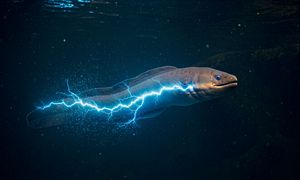
One of the most fascinating abilities found in certain fish species is the detection and use of electricity. Some fish can sense weak electrical signals generated by the muscle movements of other animals, helping them locate prey even in complete darkness. Others go a step further by producing their own electric fields. By detecting changes in these fields, they can identify nearby objects and navigate their surroundings with precision. Species like the elephantnose fish and electric eel are well-known examples of this remarkable adaptation.