June 09, 2026
Mobile phones have become an essential part of modern life. From communication and entertainment to education and business, smartphones help people stay connected to the world. While most users focus on the features of their devices, few stop to think about how these complex pieces of technology are actually made.
Behind every smartphone is a massive manufacturing process involving advanced engineering, precision machinery, thousands of components, and skilled workers. A modern smartphone contains hundreds of parts working together seamlessly, and producing millions of devices each year requires one of the most sophisticated manufacturing systems in the world.
Understanding how mobile phones are manufactured reveals the incredible amount of technology and coordination involved in creating the devices we use every day.
The Design Stage
Every mobile phone begins as an idea.
Before manufacturing starts, engineers and designers spend months, and sometimes years, developing the device. They determine the phone’s appearance, screen size, battery capacity, camera specifications, processor performance, and overall user experience.
During this stage, computer-aided design software is used to create detailed digital models of the phone. Engineers test various configurations to ensure that all components fit properly inside the device while maintaining durability and performance.
Prototypes are then created and tested extensively before mass production begins.
Manufacturing the Components
A smartphone is made up of numerous components produced by specialized manufacturers.
The processor, often considered the brain of the phone, is manufactured in highly advanced semiconductor fabrication facilities. These facilities use microscopic technology to create billions of tiny transistors on a single chip.
The display is produced separately using sophisticated manufacturing processes involving glass, light-emitting materials, and touch-sensitive layers.
Camera modules, batteries, speakers, microphones, sensors, memory chips, and wireless communication components are also manufactured by specialized companies around the world.
Because different components require unique expertise, smartphone manufacturers often source parts from multiple suppliers.
Producing the Circuit Boards
One of the most important parts of a smartphone is the printed circuit board, commonly called the PCB.
The PCB acts as the central platform that connects the phone’s electronic components. Tiny conductive pathways are printed onto the board, allowing electrical signals to travel between different parts of the device.
Modern circuit boards are manufactured with extreme precision. Automated machines place microscopic electronic components onto the board at incredible speeds.
Some machines can position thousands of components every minute while maintaining accuracy measured in fractions of a millimeter.
This level of precision is essential because modern smartphones contain extremely compact electronics.
Installing Electronic Components
After the circuit board is prepared, automated assembly machines begin attaching the various electronic components.
Processors, memory chips, wireless communication modules, power management systems, and numerous other components are carefully positioned and secured onto the board.
Specialized soldering processes create strong electrical connections between the components and the circuit board.
Advanced inspection systems use cameras and artificial intelligence to verify that every component is correctly placed.
Even a tiny manufacturing defect can affect the phone’s performance, making quality control a critical part of the process.
Manufacturing the Display
The display is one of the most visible and important parts of any smartphone.
Modern displays are manufactured using multiple layers of specialized materials. These layers include the display panel itself, touch sensors, protective glass, and various coatings that improve durability and visibility.
Display manufacturing requires extremely clean environments because even microscopic dust particles can cause defects.
Once completed, each display undergoes testing to ensure proper brightness, color accuracy, touch responsiveness, and overall performance.
Only displays that meet strict quality standards proceed to the next stage.
Battery Production
Smartphone batteries require careful manufacturing because they store significant amounts of energy in a compact space.
Battery production involves assembling multiple layers of specialized materials that enable energy storage and release. Each battery is tested for capacity, safety, charging performance, and durability.
Manufacturers conduct extensive safety checks because battery reliability is essential for both device performance and user safety.
Only batteries that pass rigorous testing are approved for installation.
Assembling the Smartphone
Once all components are ready, final assembly begins.
Workers and automated systems work together to combine the various parts into a complete device. The circuit board, display, battery, cameras, antennas, speakers, and other components are installed within the phone’s frame.
Modern manufacturing facilities use robotic equipment for many assembly tasks because robots can perform repetitive operations with exceptional accuracy.
Human workers typically handle inspections, specialized assembly steps, and quality assurance procedures.
The goal is to ensure that every component is installed correctly and functions as intended.
Software Installation
A smartphone is not complete without software.
After the hardware assembly process, manufacturers install the operating system and essential software onto each device.
This includes system applications, drivers, security features, and various tools that allow the phone’s hardware to function properly.
Manufacturers also configure settings specific to the model being produced.
Once the software is installed, the phone can be powered on for the first time.
Quality Testing
Every smartphone undergoes extensive testing before it reaches consumers.
Manufacturers test displays, cameras, speakers, microphones, sensors, buttons, charging systems, wireless connectivity, and battery performance.
Specialized equipment checks whether calls can be made successfully, whether touchscreens respond accurately, and whether wireless features operate correctly.
Many devices are also subjected to durability testing.
Some phones are dropped, twisted, exposed to temperature changes, or tested for resistance to moisture and dust.
These tests help ensure reliability under real-world conditions.
Packaging and Distribution
After passing quality inspections, smartphones move to the packaging stage.
Accessories such as charging cables, documentation, and other included items are placed inside retail packaging. The phones are then sealed, labeled, and prepared for shipment.
From manufacturing facilities, devices are transported to distribution centers around the world.
Retail stores, online marketplaces, mobile network providers, and authorized dealers receive shipments before making the phones available to customers.
The logistics involved are enormous, especially when manufacturers release new models globally.
The Role of Automation
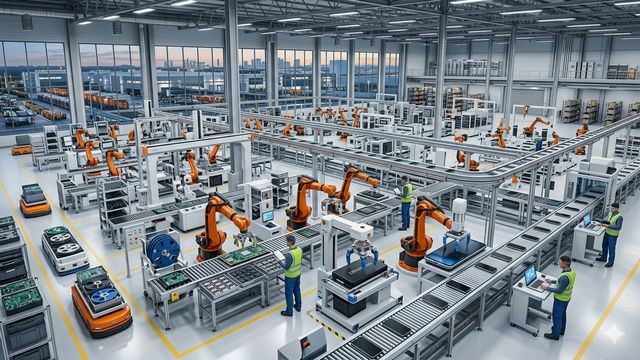
Modern smartphone manufacturing relies heavily on automation.
Robots perform many tasks that require speed, consistency, and precision. Automated inspection systems use advanced cameras and artificial intelligence to identify defects that may be invisible to the human eye.
Automation allows manufacturers to produce millions of devices while maintaining high quality standards.
Despite these advances, human expertise remains essential. Engineers, technicians, designers, and quality control specialists continue to play critical roles throughout the manufacturing process.
A Remarkable Manufacturing Achievement
The smartphone is one of the most complex consumer products ever created. Hundreds of components sourced from different parts of the world come together through a carefully coordinated manufacturing process involving advanced machinery, skilled workers, and sophisticated quality control systems.
What appears to be a simple device in your hand is actually the result of years of research, engineering, and precision manufacturing. Every smartphone represents the combined efforts of countless professionals working across multiple industries and countries.
The next time you use your mobile phone, it is worth remembering that behind its sleek design lies one of the most impressive manufacturing achievements of the modern world.